
As we all probably know, alien plant invasions are a threat to the ecological integrity of the Kogelberg Biosphere’s unique vegetation. There are at least 50 species of alien plants that have become established in the natural vegetation within the Kogelberg Biosphere. The most widespread of these (the “big five”) are Australian wattles, gum trees, myrtle, hakeas, and pine trees from the northern hemisphere. Yet despite extensive past efforts to control them, there are no accurate, up-to-date maps showing where invasions are most severe, making strategic planning and resource allocation difficult. Some estimates indicate that 11% of the Biosphere is covered by high-density alien vegetation, with 15% and 14% with medium and low density respectively.
The Kogelberg Biosphere Reserve Company (KBRC), the non-profit coordinating body for the UNESCO Biosphere, is in the process of reviewing all of the available information on the distribution of invasive alien plants, as well as the efforts that are going into managing them. Currently, there are multiple initiatives to control alien plant invasions in the Kogelberg Biosphere, with little or no central planning or co-ordination between them. These include projects run by Cape Nature, municipalities, NGOs, private landowners and volunteer hack groups. There have also been no rigorous assessments of the effectiveness of these control efforts.
South African law places a legal obligation on landowners to manage listed invasive species under the National Environmental Management: Biodiversity Act (NEM:BA). However, enforcement is weak, and many landowners are either unaware of this obligation, or they ignore their responsibilities or lack the capacity to comply. Worse still, they often actively resist attempts to clear invasive trees off their land, or to remove them from their gardens.
Fortunately, the Kogelberg has a strong tradition of community involvement. Local volunteer hack groups in Betty’s Bay, Pringle Bay, Rooiels and Kleinmond have been clearing alien vegetation for decades. The Hangklip Hardcore Hackers group, active since 1963, is among the oldest of its kind in the country. These hackers work every week to manually remove invasive plants from public and, with permission, private land. While modest in resources, their local knowledge, passion and persistence are vital. In many cases, they are the only actors undertaking follow-up clearing – a critical part of ensuring that past work is not undone.
Hackers have done a fantastic job over the past 6 decades, and many areas that by now would have been completely covered by alien plants have been cleared. In addition, the release of biological control agents (insects or pathogens from the country of origin of the plant species) has helped to significantly reduce the populations of some species. These include wattles (e.g. rooikrans and Port Jackson willows, and hakeas). Biological control is safe because the agents only attack the target plant, it costs almost nothing, and it is sustainable. Unfortunately, many of our most problematic species (gums, myrtles and pines) still do not have biological control.
Despite recent achievements, many challenges remain. Funding is inconsistent. Many landowners still vehemently refuse access to volunteers, despite the fact that they are legally obliged to take steps to remove invasive alien plants. This leaves islands of uncleared plants that remain as a seed source to re-invade areas cleared by the hack groups. Follow-up work often falls through the cracks. And while Working for Water, a national government programme, once provided substantial support, its presence in the Kogelberg has declined drastically in recent years. As a result, we are all at risk of falling behind. Without a centralised plan, duplication and inefficiency remain a risk.
The KBRC’s report has made a number of recommendations. A map should be developed showing the estimated cover of invasive alien plants in the Kogelberg Biosphere, and a management plan should be developed to prioritize interventions and to co-ordinate the activities of the various role players. A steering committee made up of representatives of the various role players should be established to monitor the implementation of the management plan. The KBRC is well placed to convene such a process, working with landowners, municipalities, scientists and community groups. A shared database and annual reporting could track progress. Community involvement must of course continue to be nurtured. The local hack groups are not only effective, but also build public awareness, ownership and social cohesion. Landowners must also be engaged – through education, assistance and, where necessary, enforcement of legal duties.
Homeowners and/or regular visitors to the Biosphere are encouraged to lend a hand by joining one of the hack groups. It is rewarding work and makes a real difference!
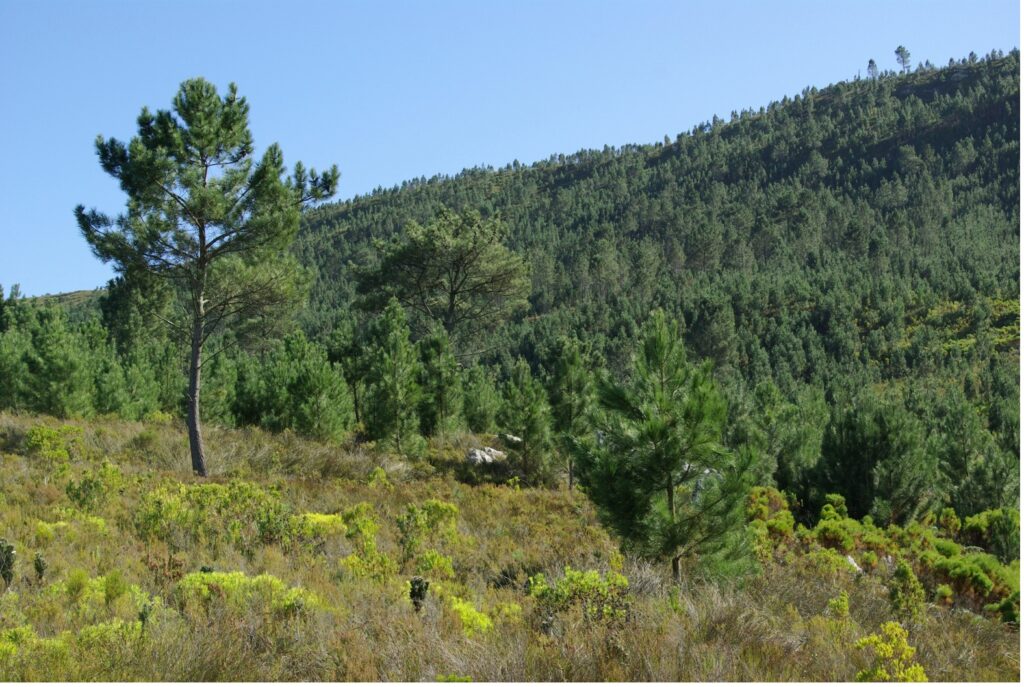
Alien pine trees invading a fynbos area, where they displace native species, use excessive amounts of water and provide additional fuel that makes wildfire more damaging and difficult to control.
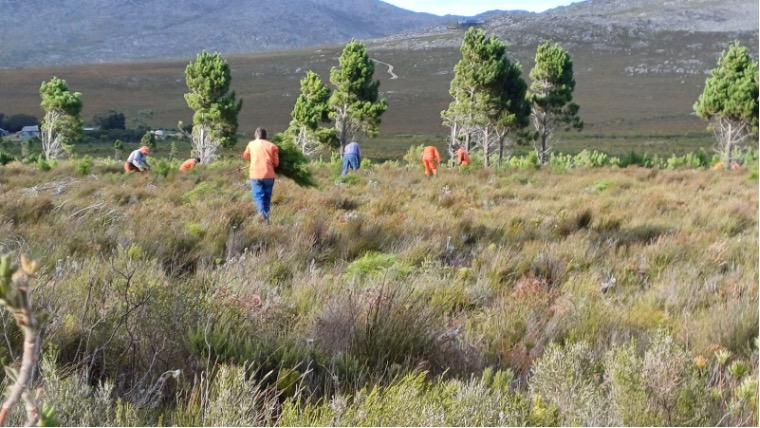
The Hangklip Hardcore Hackers group removing alien pine trees from privately-owned land in the Kogelberg Biosphere.
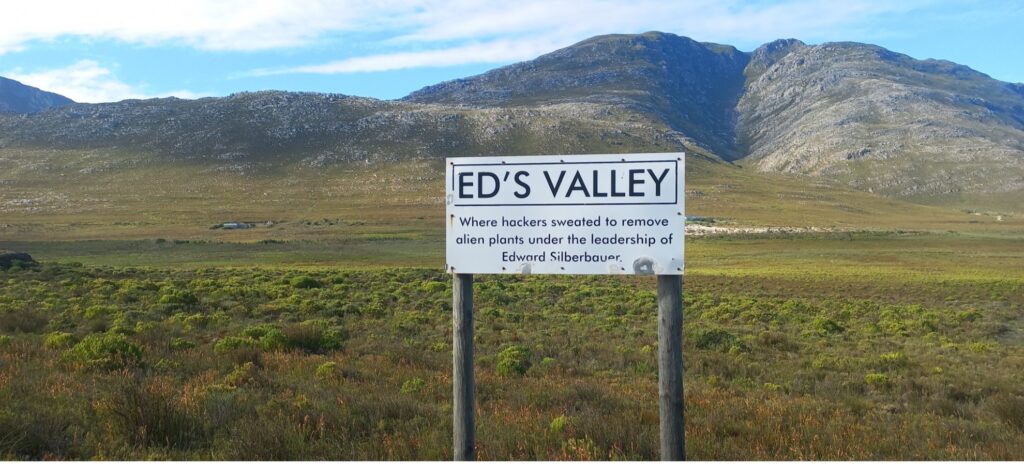
A sign erected on the Brodie Link Reserve to recognize the past efforts of the late Edward Silberbauer in leading a volunteer hack group.
Brian van Wilgen