
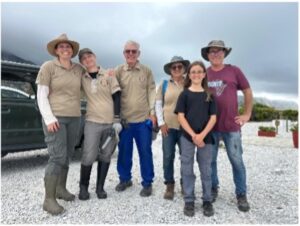
 Thirty-nine volunteers attended on an overcast and cool day to remove aliens from the verges along Porter Drive. I was informed by Dave Mourant that this was a record attendance. This hack coincidently marked the 63rd anniversary of the Battle for Betty’s Bay which started in February 1963. It is thanks to willing volunteers such as these that this proud tradition has continued and stood the test of time. It is also remarkable that only 14 of these monthly hacks have been missed over all these years.
Ronell and Rinze Wouda, Tanya Gorlee and Mark Edmonds were welcomed as first-time Betty’s Bay hackers, as were Ash van Zuydam, Gerda Theron, Andre Deschodt and his twelve year old son, Ben of Kogelberg CREW (Custodians of Rare and Endangered Wildflowers) who were invited by seasoned hackers and fellow CREW members, Gemma and Jeremy Cronin. Their presence was to participate in the global day declared by IUCN (International Union for Conservation of Nature) calling for action to protect threatened plants. We sincerely hope that all the newbies thoroughly enjoyed their hack and will be back for many more.
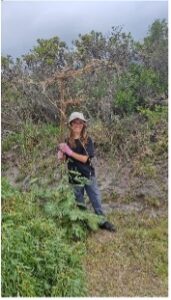
 The hack started at Delport Road on the western side of Betty’s Bay and moved eastwards. Vehicles were shared and teams kept leap frogging as we progressed down Porter Drive, cutting, poisoning and dragging branches from the verges which in many places are fifteen metres wide.
The mid morning break was taken at 10am at the St Francis Chapel. This was thoughtfully arranged by Tim Attwell and proved to be the perfect venue. Many thanks to Tim.
Thank you as always to Dave Mourant who each month provides all that is needed for a good cup of tea or coffee, more so in this case as he had to drop everything off at the chapel at 8am as he unfortunately had to miss the hack and trek off to Stellenbosch. A huge, huge thank you to Anne and Dave for sponsoring and making four loaves of delicious egg mayo and tomato & onion sarmies, double the normal amount but eaten in half the time by the masses.
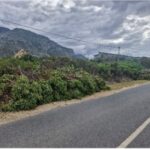 After refreshments, the hackers returned to where they had left off. By the end of the hack, 2km had been covered, up to Crassula Avenue, and 27 heaps of branches made, primarily of rooikranz but also blackwood, myrtle and Acacia elata.
The aftermath was enjoyed by all in the chapel courtyard. This was another very productive hack with amazing volunteers who find where they fit in best and simply get stuck in and get the job done.
 Our thanks as always to our hacking neighbours from Kleinmond, Rooi Els and Pringle Bay who put in a special effort to attend – Christine Coupar, Mike Christelis, Anne Woods, Chris Geldenhys, Chris Cadman, Ken Meiring and Brian McMillan.
Ad hoc Hack, Tuesday, 20 January 2026, 07:45 – 09:20 – Viv von der Heyden, Dave Mourant, Paul Whitelaw and Rob Boyd.
5550 Pearl Drive, Sunny Seas – private property. Popping, lopping and chainsaw work to remove New Zealand Christmas trees, banksia, bottle brush and rooikranz. Our thanks to Walther for his generous donation.
Ad hoc Hack, Tuesday, 20 January 2026, 09:30 – 10:30 – Viv, Dave, Paul and Rob
3384 Pearl Drive, Sunny Seas. Public open space. Chainsaw work and poison. Large Showy Honey Myrtle and Port Jackson on the verge, large bottle brushes and large Acacia longifolia in the open space. Many thanks to Mary and Paul Whitelaw for the aftermath with a sea view at their home.


Showy Honey Myrtle (Melaleuca nesophila) Image on right credited to iNaturalist
As ever, on behalf of the Betty’s Bay Fynbos, thank you all for your efforts.
Rob Boyd
Convener Betty’s Bay Hack Group
Showy Honey Myrtle, an import from Australia, is considered an alien plant showing signs of becoming invasive in the Western Cape. The plants that we removed from 3384 Pearl Drive had spread from the garden across the road. Unfortunately, like the Bottlebrush, Banksia, Australian Tea Bush and other invasive species, the plants are still being sold by nurseries. For the sake of our own showy, beautiful world-renowned fynbos, please remove these from your gardens and verges! For images of the most common aliens in the Western Cape see
https://invasives.org.za/wp-content/uploads/2022/05/Western-Cape-IAPs.pdf
Editor