
BBRA Membership: BBRA members and all future members should take note of the new BBRA Application Form (attached). The new form needs to be signed by all members, even if you are paid-up for 2025/26, as the issue pertaining to the POPI Act is addressed.
Being a Member has the following advantages:
- Inclusion in the Betty’s Bay Neighbourhood Watch (BBNW), Betty’s Bay Emergency Support Team (BEST) and Betty’s Bay Fire and Rescue Volunteers;
- Effective community representation in the Overstrand Municipality, Community Policing Forum, DFFE, Cape Nature, SAPS, Ward 10 committee, the Stony Point Protected Area Advisory Committee (PAAC) etc.;
- Monthly BBRA Newsletter, active Facebook page, Instagram, and BBRA website; and
- Access to relevant community WhatsApp groups for safety and updates.
BBRA focus points for 2026: Without going into detail, and apart from the normal work undertaken by the different portfolios within the BBRA, we will concentrate this year on (i.e.) the following:
- Financial transparency regarding the BBRA Finances.
- Day-to-day operations under the different Portfolios within the BBRA.
- Assisting the Overstrand Local Municipality with the update / amendment of the current Spatial Development Framework (SDF) for Overstrand / Precinct Plan for Betty’s Bay.
- The development of Erf 4030 Betty’s Bay as a user-friendly area for all the residents of Betty’s Bay.
- The renovation of the parking areas at our beaches – Main Beach and Silversands.
- The renovation of the ablution blocks at our beaches – Main Beach and Silversands.
- The renovation of the parking area at the development at Coffee on Clarence to alleviate traffic problems in the broader area.
- Strongly supporting all legal engagements / actions regarding the curbing of speeding on Clarence Drive.
BBRA Portfolios: Please note the different portfolios under the BBRA and that any relevant day-to-day issue can be forwarded to the BBRA’s email address bettysbayratepayers@gmail.com
3 (THREE!) Minutes more 60km/h through Betty’s Bay on R44
Our village is situated within the transitional zone of the UNESCO designated Kogelberg Biosphere. Excessive speeding and ridiculous speed limits – and exceeding them – have been allowed through our village for long enough. It will take less than three minutes longer than at current speed limits to pass through Betty’s Bay, when driving at 60km/h. Noise levels are excessive. Our precious wildlife is being killed. More accidents are waiting to happen. Tourism is our main business. Our penguins, all our beaches, most of our businesses (and with more to come), multiple residential driveways, our library and our town dump – all are accessed off Clarence Drive. The distance through is 10.4 kms and it will take 10.4 minutes, driving at 60km/h. Or let’s say 10 minutes for 10 kilometers. just three minutes more of your time.
Support driving 60km/h through our village on Clarence Drive by signing the petition below.
Our Precious Wildlife (Plea by Wayne Jackson)
We have already lost one life on Porter Drive. We cannot, under any circumstances, allow it to happen again.
A second caracal kitten has just been sighted in the exact area where its sibling was killed recently. This kitten is currently exploring and learning to navigate our world alongside its mother. Very soon, it will begin to extend its range and seek out its own territory. Its survival depends entirely on us.
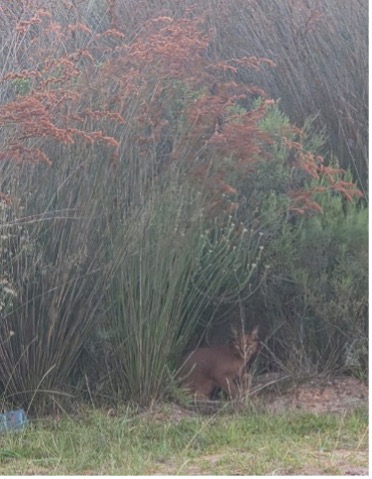 For the next three months at least, consider the section of Porter Drive indicated in the map below a mandatory go-slow zone. I am pleading with you to recognise the gravity of this situation, but I am also stressing that we hold ourselves and our neighbours accountable.
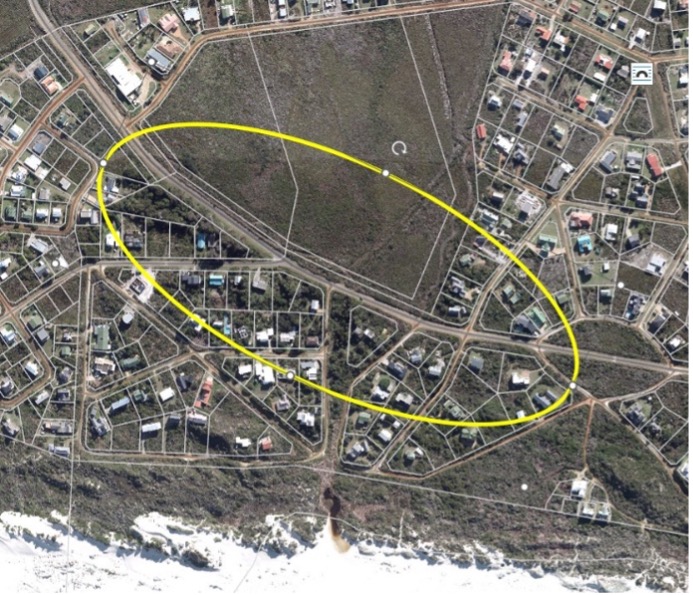
Please ensure every friend, visitor, and neighbour is informed: speed in this area is no longer an option. We have a collective responsibility to ensure this kitten reaches adulthood.
Some interesting facts about our area:
Did you know Betty’s Bay sits on one of the oldest human coastlines on Earth?
Many people think the human history of the Cape goes back a few hundred or perhaps a thousand years.
In reality, the story of the people who lived along this coastline stretches back tens of thousands of years.
Southern Africa is widely recognised by scientists and archaeologists as one of the oldest continuous homelands of modern humans on Earth.
The ancestors of the Khoisan peoples lived in this region long before the pyramids of Egypt were built, long before written history began anywhere in the world.
By at least 160,000 years ago, early humans were already living along the southern Cape coast, gathering shellfish, fishing in the tidal zones and making use of the incredibly rich marine environment.
Some of the earliest archaeological evidence of coastal living by modern humans has been found not far from here at places like Blombos Cave and Pinnacle Point.
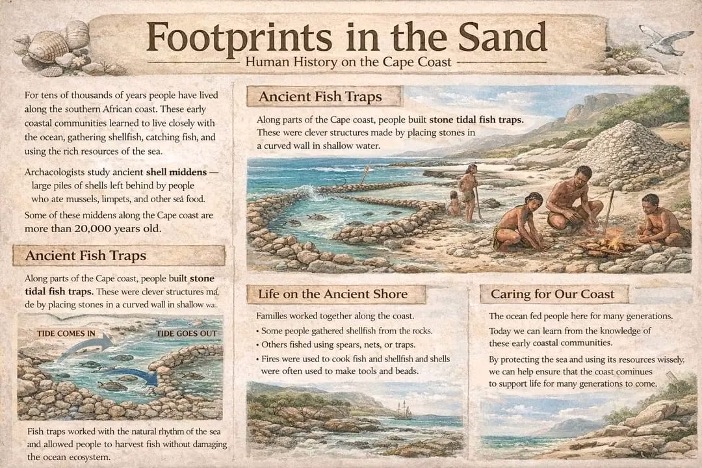
Along our own Betty’s Bay shoreline, quiet traces of this ancient way of life still remain.
If you walk the coast carefully, you may notice shell middens — small mounds of shells that accumulated over many generations.
These middens contain oyster, mussel and limpet shells left behind after countless meals beside ancient fires. Some are hundreds to thousands of years old, forming part of a much older cultural landscape.
Another remarkable feature along our coast are the stone fish traps. Built by arranging rocks into curved walls in the shallow intertidal zone, these traps work with the natural rhythm of the tides. As the tide recedes, fish become temporarily trapped within the stone walls, allowing them to be collected easily.
These structures show an ingenious understanding of the sea — sustainable harvesting methods developed over many generations of coastal living.
Imagine standing on this same shoreline a thousand years ago…
or five thousand,
or perhaps even longer.
Families gathered around fires near the rocks.
Children exploring the same tidal pools.
People harvesting mussels and fish from the same ocean that sustains life here today.
The landscape has changed, but the story of the first coastal people of the Cape still lives quietly in the stones, shells, and tides of Betty’s Bay.
Please remember that shell middens and ancient stone structures are protected heritage sites and should be left undisturbed so future generations can learn from them.
🌍 The next time you walk along the Betty’s Bay shoreline, remember:
You are not just walking along a beach — you are walking through one of humanity’s oldest living landscapes.
Images created collaboratively by Sonja Wray & AI.)
Amund Beneke