
I missed the 9 June Community Engagement due to illness, but on 9 July I heard a shortened form of the SANCCOB and CapeNature presentations at the Protected Area Advisory Committee (PAAC) for Stony Point Nature Reserve and MPA.
Here are some of the points and my thoughts:
- The drastic decline in the number of breeding pairs of the African Penguin
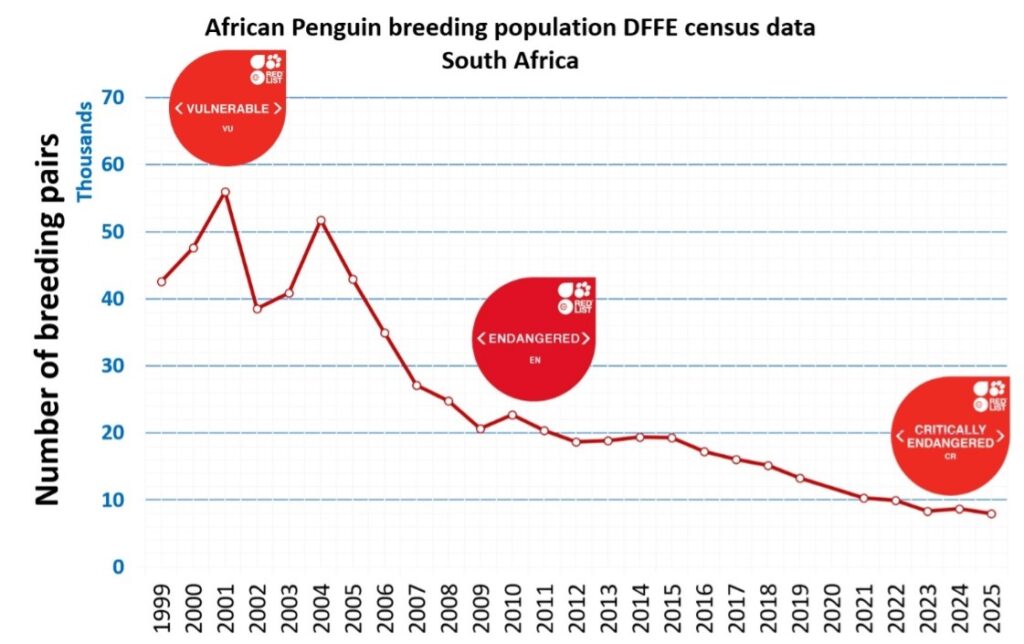
Lisa Nupen of SANCCOB presented this graph. It shows the steady decline in the number of breeding pairs since 1999, and the corresponding change in the International Union for Conservation of Nature (IUCN) Red List of Threatened Species https://www.iucnredlist.org/.
The African Penguin dropped to Vulnerable in 2002, Endangered in 2010 and to Critically Endangered in 2024. The next level of listing is Extinct in the Wild (EW) i.e. meaning it only lives in captivity, and then Extinct (EX) when there are no living individuals left.
- The organisations working to protect the penguins
SANCCOB, supported by organisations such as BirdLife South Africa, CapeNature and many dedicated volunteers, is working tirelessly to support the African Penguin. They incubate eggs that need to be rescued from colonies, hand-rear chicks, rescue sick or injured juveniles and adults, give veterinary care and perform surgeries to save birds, and release penguins that are able to return to the wild. They also collect data, conduct research, prepare for disasters, support SANCCOB Sea Rangers at colonies, source funding, educate the public, train volunteers, network with other organisations, and more.
Alongside BirdLife SA, they fought for fishing closures around penguin colonies to improve food availability. They understand the specific marine and land threats to the African Penguin at the different colonies. Their Seabird Rangers, CapeNature staff and the SANCCOB centre see the grim consequences of all the injuries and predator kills. SANCCOB remains committed to securing a future for the African Penguin.
- The stats for the land predation at Stony Point
These show a marked increase in caracal predation in 2025 and 2026. In 2026, up to 8 July, caracals have killed about 60 adult penguins. A lot of this is surplus killing i.e. the caracal doesn’t just kill what it wants to eat, it kills and leaves the carcasses.
- For a critically endangered species, each bird is vital
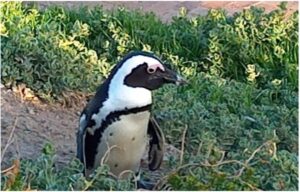 The death of one adult means the loss of a breeding pair and the loss of their current eggs or chicks for this breeding season, as a solo adult can’t raise the eggs or chicks alone. Beyond that, it also means this ‘pair’ isn’t able to breed in future years and, therefore, the loss of their potential eggs and chicks in all future seasons. It is also the loss of all their eggs and chicks as future breeding adults and all their potential offspring. Together, these are far-reaching consequences for a species with possible extinction in the wild, hanging over their heads in less than ten years.
Sixty dead adults in the last six months is a devastating loss for the Stony Point population. If this predation carries on, the population at Stony Point faces an even more serious crisis.
- Land-based colonies like at Stony Point and Boulders face both marine and terrestrial threats
Penguins used to live on islands and burrow in guano for their nests. They aren’t adapted to land predators, and do not have much defence against them, so they are very vulnerable.
At sea, these predators include seals and sharks that prey on the penguins, fishing stress with low food availability, oil spills, increased marine traffic and noise pollution, and marine pollution.
On land, the threats include mongooses, caracals, kelp gulls, humans, dogs, cars, the loss of breeding habitat, climatic events and others.
- Human stress
People are a stressor for penguins, especially with the insatiable drive of those who want “close-up selfies” to post on their social media accounts to boost their egos with lots of “likes”! The “cute” birds may not look stressed, but their internal stress responses rise. Remember, they used to live on islands without daily invasions of curious human visitors.
- Access times and entrance fees
Many people seem to view Stony Point as a freebie place to come and go as they like. People enter at all times in the mornings and evenings, due to faulty gates, when the reserve should be closed to visitors. Tour companies include Stony Point in the cost of their packages, but their clients can visit the reserve without paying entrance fees if they don’t go on the boardwalk. The same goes for ‘kombi tours’ and private individuals.
SANParks and other CapeNature Reserves charge entrance fees. This is one way of raising revenue to cover conservation and other reserve costs. Because of the faulty gates and the current pay-point, Stony Point has lost revenue that would normally contribute to CapeNature’s management of its reserves.
The plan is to fix the gates at Stony Point. These will close when the reserve closes at 4:30 p.m. in winter and a later time in summer. Most ‘day’ reserves are closed ‘after hours’ when the staff leave. The penguins should have time out from human interference by visitors.
- Should there be a social venue open at night in the midst of a conservation area for a critically endangered species?
I will leave that for you to consider.
- Proposed change in visitor flow and a new pay-point
The pay-point will be moved from its current site on the boardwalk. Its new site will be to the right of the restaurant – near the ramp from the small car park near the CapeNature office. Visitors will be directed via railings.
Visitors won’t pay to visit the restaurant. They will only pay to go into the penguin area – on the left of the coastal area, or right, onto the boardwalk.
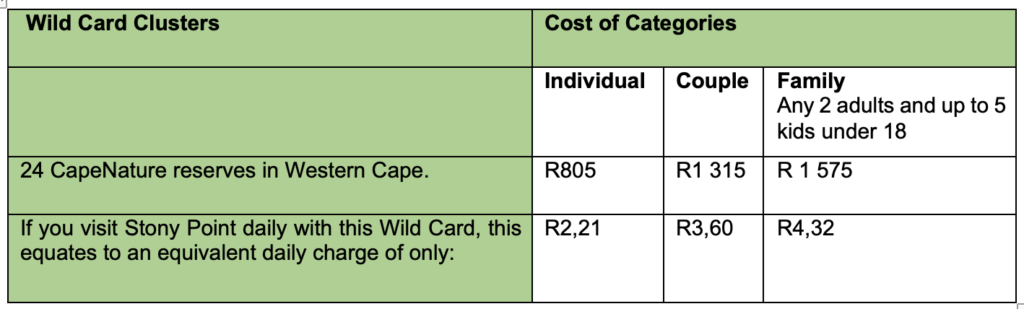
- Wild Card
Visitors and residents can use a Wild Card at the pay-point.
- The Fence
The growing use of fencing in the village is fragmenting what were once open corridors for wildlife. In recent years, so many new homeowners have fenced their properties, dividing the village’s natural spaces into ‘blocks’ that inhibit wildlife movement. However, many homeowners have dogs and these pets need to be ‘fenced in.’
Most reserves are fenced.
The installation of a predator-deterrent fence has been motivated by the increased and devastating caracal predation over the past 18 months. The fence is a black, 2.1 m Clearview structure with a 50 cm overhang at 45 degrees, and with a cement base dug underground to prevent predators from digging under the fence.
- There are many concerns and questions:
- Why has caracal predation increased? What factors have changed? Are there more caracals in the area? How many caracals are doing the killing? Is there time to wait and do research to find this out – while losing so many breeding adults to predation?
- What is currently being done to stop the predation? There are camera traps to monitor the caracal activity, baited traps to try to catch and then relocate the caracals and staff presence at night. Penguin-Pals patrols will also be implemented.
- What will happen to the penguins who are currently breeding outside the designated colony area when the fence is installed?
The intention is to bring these birds back into the colony before it is fenced. Being ‘naïve’ about land predators, humans and cars, the penguins are at risk outside the colony area.
- If they chose to nest outside the colony for a reason, will they try to go back to those sites?
This is a big concern of many residents. The fence does not have ‘penguin gaps’ for any penguin outside to get back into the colony (should they have made it out) before the gates open in the morning. Gaps like this would be an open invitation for caracals to get through.
- Will this cause increased stress for penguins who may try to go back to ‘their spot’ outside?
There is currently no clear answer to this, and it will need to be monitored and responded to with adaptive management.
- Will the construction disturb and stress the penguins?
To mitigate this, the initial phase has been planned for October – December at a time when the penguins’ movement is less, as they are moulting. Construction workers will be educated and working hours per day will be limited to times when the penguins are less active on land.
I understand that the organisations are desperately working to protect the African Penguin at Stony Point – to try to give them a chance to recover their breeding success and save the population. Each colony has a slightly different group of factors that threaten the penguins. At Stony Point in the past 18 months, caracal predation has increased and become a major factor threatening the survival of the colony. The predator-deterrent fence is seen as a means of mitigating the predation of a critically endangered species in crisis.
If nothing is done – what will happen at Stony Point if predation of this number of adult penguins continues or increases during the next crucial nine years as the clock ticks towards their potential predicted extinction in the wild in 2035?
Positive observations since the fishing closures are that the penguins are in better physical condition – but the sad situation is the caracals are now killing “better-fed” penguins. Having won one battle, there is now another to fight in the survival of this crucial species.
- How does this affect us as Betty’s Bay residents in 2026?
- Stony Point is a conservation area for a now critically endangered species.
- I think it’s time to change our thinking and behaviour to match their crisis state. We need to help to support this colony and the organisations that manage and support it. That’s an aim of the BBC Penguin-Pals, initiated in 2024.
- We need to embrace a role as custodians of our neighbours in crisis.
- The vision of a Betty’s Bay community project
Supporting the organisation and the Stony Point colony could be a significant Betty’s Bay community project. The village is full of people with an amazing variety of skills, as well as time availability.
If you would like to be involved in the BBC Penguin-Pals in some way, please email bettysbayconservancy@gmail.com or WhatsApp 079 753 0166.
The last Penguin: Credit to The Current Times and Jan Schaafsma
You might have read this on page nine of ‘The Current Times’ as a runner-up to their Long Short Story Competition.
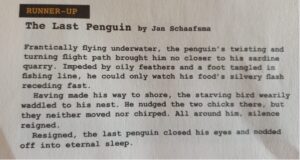
May it never come to this at Stony Point!
As a village, let us join our good attitudes, willing hands, skills and time to support our neighbours in crises.
Carol Clark