
The wildlife awareness signs initiative was met with great enthusiasm and 44 beautiful signs were sponsored. Huge thanks to the sponsors and to Pete Oxford, resident wildlife expert, and Renee Bisch for ensuring that the animals look like OUR animals with the help of their very generous designer friend (who prefers anonymity), and to the Betty’s Bay Baboon Action Group(BBBAG) and the Betty’s Bay Conservancy (BBC) for helping to spread the news.
Subsequent to the receipt of Marelize’s contribution the following news was received from her and added here…(Ed)
Dearest Sponsors of 44 beautiful wildlife awareness signs.
Our signs were approved by the Overstrand Municipality with the agreement that they will install them if we provide them, specifically with the condition that they be made according to road sign specs, and specifically that the OM approves the final animal designs. THIS WAS ADHERED TO. The process took about 4 months. Last night I received the devastating news that this permission has been withdrawn after a meeting between OM, the BBRA and Theresa Els. An alternative format was not offered – the sign with the ! on was offered with ‘Wildlife’ added below. OM would install them throughout the village – where they deemed appropriate.
All of the generous sponsors were contacted individually, and as expected and understandably, full refunds were requested by most.
This….

With underwriting …WILDLIFE
as opposed to this …
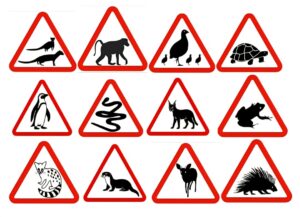
It would be interesting to hear comments from the residents of Betty’s Bay! Ed.
The following issues were forwarded to the Ward 10 Committee for their next agenda and to take further up the channels at OM – the way it has to be done:
- Waste management: domestic and public spaces. Various issues in our village have been raised. A suggestion has been put forward from a resident for concrete/brick baboon proof bins in public municipal spaces and a request, to at own cost, build a prototype.
- Petrol station advertising lights (established – no permission requested for doing so). May that switch be flicked off very soon!
- Feedback requested on the establishment of the HCOZ – a Hangklip Villages Conservation Overlay Zone – that has been in the making for quite some time and would provide a legal vehicle to address disturbing residential lights.
- It would be amiss not to mention the extreme concern of a large portion of our residents around current baboon management strategies, and the postponement of the revision thereof.
- The penguin fence and CapeNature – another polarising and important issue in our village. Below is an article, kindly forwarded by the author to publish here, that appeared in the Overstrand Herald regarding the third public information session.
Penguin Fence Update
Following the Friday 28 August Penguin Fence information sharing session, hosted by CapeNature, I have put together an overview of what was discussed and, more importantly, what I believe emerged from the meeting. If I was reading the room correctly here are my thoughts:
CapeNature began the meeting by informing that the proposed Phase 2 and 3 of the fence construction had been abandoned.
We were left to discuss Phase1 which consists of a tall fence, along the existing fence line of Wallers Road, including the gates, following up Una Drive, incorporating the CapeNature offices and joining the current ClearVu fence. The proposed new ClearVu fence will be a total of 2.35 meters high, including the 50cm, 45 degree angled top, which will angle towards the road.
The current fence in that stretch is a one meter high, wooden and mesh fence, which, critically, is porous to penguin movement. CapeNature describes Phase 1 as an ‘upgrade’ and ‘replacement’ of the current fence to make that ‘front’ (road frontage) section predator proof. It was argued that the new fence was far more than a replacement or upgrade as its core function would change. Yes, it might largely deter the 1-3 possible caracals accessing the colony from that direction only (less likely so for mongoose, identified as the second biggest threat) while still leaving the rest of the colony exposed for a caracal to simply walk around. However the fence would also deliberately restrict access to breeding sites, chosen by the penguins themselves, to areas in and beyond Wallers Road, Una Drive and Rocky Ridge Road in particular, where a significant number of penguins have currently chosen to nest. These birds would be cut off from those breeding sites.
Caracals have been shown to have a non-sustainable, negative effect on the Stony Point penguin population, being identified as responsible for 70+ adult penguin deaths so far this year. CapeNature believes that more than 1 and up to 3 caracals are responsible, while mongooses (among others) are known to predate on eggs and chicks. This high rate of caracal predation has manifested largely over the past 18 months (although 220 adult birds were identified as having been predated by suspected caracal in 2015) with little direct mitigation to date.
It was generally agreed that there was a desperate need to finally fix the broken entrance gates, to restrict the high volume of after hours, unattended visitor presence causing unwarranted disturbance to penguin movement and well-being. The ‘people barrier’ was welcomed, but not at the cost of restricting penguin movement. It was also suggested that, in line with other CapeNature visitor sites, an on-line booking system be put in place.
The previously proposed use of Maremma guardian dogs was dismissed, after CapeNature consultation with an upcountry farmer who uses Anatolian sheepdogs to protect livestock, on the basis that the dogs would not bond with the penguins. This has been shown to not be the case, in Australia at least, where Maremma dogs fully ‘bonded’ with Little Penguins and act as their guardians against fox predation in an ongoing medium-to-long-term very successful project resulting in penguin numbers increasing.
Although other examples were raised of fencing having success against predation of ground-nesting birds, particularly in Hawaii, these were not directly comparable to our situation at Stony Point.
CapeNature proposes to undertake an Integrated Management Plan, including more ranger presence, volunteer night patrols, live-feed night vision cameras, caracal ‘scaring’ barriers, discussing outsourcing of professional caracal capture/relocation as well as, importantly, rehabilitation of the existing hard, dry, hot and barren core area of the human delineated colony. Actions which have been sorely missing to date. Part of the plan is to put in a fully functioning irrigation system to stimulate vegetation regrowth in the area, along with extra artificial penguin nest boxes. It is known that, despite availability of artificial boxes, penguins still prefer the microclimate stability of burrowing under dense vegetation. African penguins are hard-wired genetically as burrowing nesters (as are all four species of the Spheniscid group) and, until such time as the core area is fully revegetated it is only natural that they prefer nesting away from this ‘moonscape’ in more optimal sites. Coupled with scientific and observational evidence, if we reason that ‘penguins know best what penguins need’ then, for the sake of maximizing their breeding success, it was motioned that they should be allowed to chose for themselves. So went the debate.
If the 1-3 ‘problem’ caracals associating with the colony were to be professionally caught and relocated (perhaps with a GPS collar to monitor any return) then the professed threat of penguins being at risk of predation outside of the ‘designated colony’ becomes moot.
With a fully rehabilitated core area, which may take a few years, penguins will most likely tend to return as it is closer to shore, but not until then, if they have ‘better’ places to go.
Penguins at Stony Point are under huge stress. Firstly, they are already returning to shore underweight (linked to low prey abundance caused by overfishing). Within the next month or two it is proposed to ‘break ground’ for the fence. This time-frame coincides with the most stressful period in a penguin’s annual cycle, when they undergo a ‘catastrophic’ moult, shedding and regrowing all their feathers in a single moult. For an already underweight penguin, who may not have sufficient fat reserves for a successful moult, this is even more stressful than normal. Two external ecological factors are now also in play. Firstly, there is a massive sardine die-off, possibly due to Pilchard Herpesvirus, PHV. Sardines are the principal prey item of penguins. This will have an unknown effect on penguins but is widely presumed to be negative. Coupled with a massive El Niño event predicted, the core colony area will tend to bake and overheat making dense vegetation cover in other areas all the more necessary for breeding success. The remaining sardines are likely to move away from traditional areas, following their preferred cold water temperature gradient, forcing penguins to range further for less reward.
All of the above scenarios compound extreme stress for the colony. It was argued that no further impositions should be presented to them, such as restricting their chosen movements or allowing anthropogenic disturbance. And, as indicated in the national African Penguin Biodiversity Management Plan, expansion of a breeding colony, rather than a restriction, should be encouraged.
It was generally apparent that the audience found it very hard to understand/rationalise CapeNature’s stance on the need for a predator proof section of fence while leaving large stretches (more than 100 meters) of the colony open and exposed to predator access. Why add to a penguins stress by restricting its choice of nesting site while the Phase 1 fence cannot be seen to be an effective barrier against caracal and mongooses anyway?
An elevated boardwalk was proposed along the existing coastal path, adjacent to where penguins currently gather on the shoreline before moving inland. This boardwalk idea would allow a free-flow of penguins underneath, from the ocean to nesting sites, without massive disturbance currently from visitors, well-meaning or not. Penguins, like most species, will quickly acclimatise to the presence of people if they remain ‘confined’ to a restricted area.
We were told that funds for the fence come from a private, undisclosed, donor. It is typical within the philanthropic community that such donations are for infrastructure rather than extra staffing or wages. If that is the case, then perhaps CapeNature could explain nicely to the donor the mitigating circumstances of unforeseen ecological disasters, and, through ’no fault of their own’ reasoning, that the best outcome and use of funds might be the boardwalk infrastructure over the fence (simultaneously implementing the Integrated Management Plan) then, I personally believe, the high tensions surrounding the issue will dissipate and the penguins might be better off.
In short, the prevailing mood of the audience seemed to be:
- Make the fence a people fence to prevent after hours penguin access (Note: This is largely the case anyway if only the gates were fixed). Such a fence need be only 1 meter or so and must be ‘penguin porous’.
- Agree to an elevated wooden boardwalk to manage visitor access and allow unrestricted penguin movement between nesting areas and ocean. Visitor flow management and information sharing must be enacted.
Pete Oxford
Submitted by Marelize Smith