
BBC4thSATURDAY: JANUARY 25 – Elements influencing the character of the built environment

Raymond Smith, a Betty’s Bay resident for 22 years, a Built Environment Specialist, an Accredited Heritage Practitioner and a Registered Architectural Professional, took us on an interesting and fun video journey of the “The good, the bad and the ugly” of the built environment in Betty’s Bay.
What a variety of housing designs there are in Betty’s Bay!
He then looked at some elements of design, illustrating the concepts with “good” and “not so good” examples of houses in Betty’s Bay:
- Boundary walls – permeable for wildlife movement
- Security – keep it invisible
- Waste pipes – keep them out of sight
- Driveway treatment – keep it permeable
- Scale – keep it realistic and break it into volumes
- Proportions and fenestrations – keep it sensible
- Form – keep the geometry simple and refrain from exotic styles
- Exterior rendering and colours – keep blending in
- Landscaping and vegetation – keep it indigenous
- Outside lights – keep them down
- Contextual relationships – keep in touch
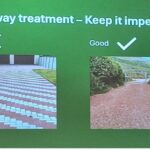
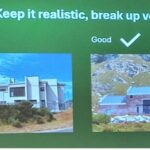
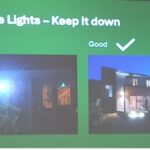
As you drive around Betty’s Bay there are many houses that have been built in a “biosphere friendly” manner. These houses blend in so well with the environment and take their neighbours and the flora and fauna into consideration. On the other hand, there are many examples of houses that are very “out of context” for the Kogelberg Biosphere. Some of these are a mix of huge and out of scale houses, very bright and excessive outside lights, solid boundary walls, electric fencing, gardens devoid of indigenous vegetation and hardened or impermeable driveways
Thanks, Raymond, for a very enlightening presentation. We look at houses with new eyes!
PENGUIN RELEASE AT STONY POINT 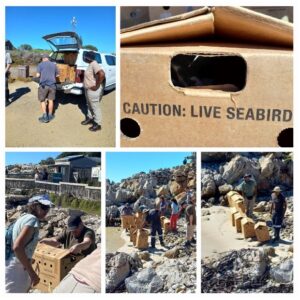 SANCCOB saves seabirds made use of the great weather conditions on 14 January to release 18 African Penguins and one cormorant at Stony Point.
Some of the birds were adults that SANCCOB had rehabilitated and which were now ready for release. Others were younger birds which had been raised at SANCCOB. Well done to SANCCOB and CapeNature for all their work in supporting the critically endangered African Penguin.Use this link to watch the first 15 penguins exiting their travel boxes and heading for the sea. https://www.youtube.com/watch?v=MbjndeYhelI
WOULD YOU LIKE TO BE A BBC PENGUIN-PAL VOLUNTEER?
It is a great opportunity to help the African Penguins at Stony Point!
In February 2024, we put out a call for residents to join the BBC Penguin-Pals to assist CapeNature and SANCCOB in their work with the critically endangered African Penguins at Stony Point.
An enthusiastic group of volunteers underwent a short “Drivers” training by SANCCOB at Stony Point. Most of them also chose to complete some additional training to be First Responders, at SANCCOB in Table View.
Since then, these enthusiastic BBC Penguin-Pals have been amazing in their passion and willingness to respond to call-outs from Stony Point staff when they have located injured or sick birds.
Once the staff have secured the birds in SANCCOB transport boxes, our volunteer’s drive to Somerset West to the meeting point with a SANCCOB driver, who then transports the birds to the SANCCOB centre.
The BBC Penguin-Pals have completed about 100 trips – transporting adults, juveniles, chicks, eggs or carcasses. Each trip gives the injured or sick birds, or eggs that have required removal, a chance of treatment and survival. This is vital to help the declining numbers of the African Penguin. Every penguin counts!
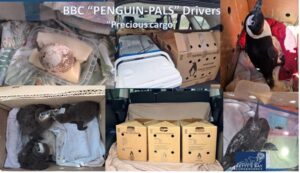
During last year, some of our Penguin-Pals relocated from Betty’s Bay, so we are opening up another opportunity for additional volunteers.
You could volunteer to be a “Driver” or you can join a new BBC Penguin-Pals initiative to help educate visitors at Stony Point, and keep a watchful eye for unsuitable behavioUr that may stress the penguins. Volunteers will have basic training and wear identification vests or T-shirts so the public is aware that they are BBC Penguin-Pals working with CapeNature.
We also have volunteers who help load hacked material and transport it to the colony for nesting material, and who help bundle this material to make it easier for the staff to carry into the colony.
Are you interested in helping?
Please email bettysbayconservancy@gmail.com or WhatsApp 079 7530166 and tell us how you would like to be involved with the BBC Penguin-Pals.
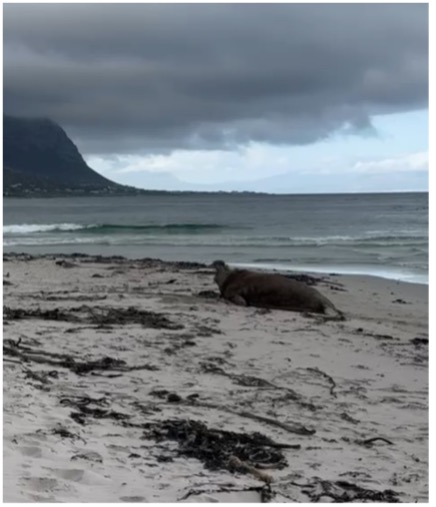
WHAT HAPPENED TO SOME OF THE WILDLIFE DURING THE HOLIDAY SEASON?Dappat visits Betty’s Bay.
After Bakkies spent a lengthy stay in Betty’s Bay recently while he underwent his moult, we had a brief visit from another elephant seal called Dappat. He had a tag from a previous visit to Dappat se Gat. Thanks to Renee and Johan for keeping an eye on Dappat to ensure his safety and that of the people walking past him.
UPDATE ON THE OYSTERCATCHER CHICKS AT MAIN BEACH
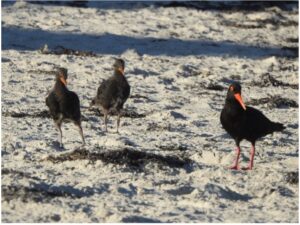
Our 2 chicks have survived after a hectic holiday season, which coincides with the breeding season. This puts the Oystercatchers under additional threat as humans and dogs invade their space.
The chicks are now 38 days old and are starting to resemble their parents. Chicks usually fly (fledge) when they reach two-thirds of the adult mass and when they are 40 – 45 days old. They are still vulnerable until they are able to fly.
Chicks are dependent on their parents for food for many months while they learn to forage. It takes up to 6 months after fledging for chicks to leave the parents’ territory for nursery areas.
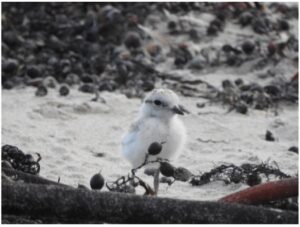
As Oystercatchers are territorial, they will remain and defend their area for the rest of their lives, up to 20 years. This means that we can expect the same pair to breed on Main beach next summer! This pair raised one chick last season on Main beach.
An added bonus was spotting a White-fronted Plover chick in the same area on Main beach.
A huge thank you to the many caring people who have observed the signs and kept their dogs leashed. People helped in many ways and showed an interest in saving our shorebirds. We appreciate your help and concern.
Watch the parent feeding their chick: https://www.youtube.com/watch?v=oR0aKuWZ7UI
3 FEBRUARY:
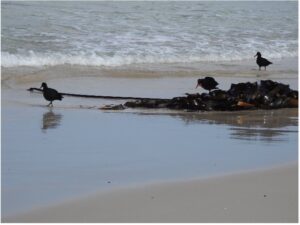
Sadly, the breeding pair have now lost one of their chicks. The chick was 42 days old and close to fledging. There is no evidence available to understand or explain what may have caused the disappearance. It could be drowning due to the recent high tides, (although chicks can swim), natural predation, or even an attack by a dog off leash.
On a more positive note, the remaining chick is now 52 days old and able to fly, which makes it less vulnerable. This chick will remain with its parents for another 2 – 4 months. It relies on the parents for feeding until its beak strengthens enabling it to pry open mussels and limpets independently. The chick will then fly to nursery areas along the coast of Namibia or Angola and remain there for 2 – 3 years until it returns to its birthplace.
Lenore and Duncan Watermeyer, Betty’s Bay Oystercatcher Monitors
SPEEDING ON THE R44
SLOW DOWN FOR LIFE ON THE R44!
ANOTHER WILDLIFE FATALITY ON CLARENCE DRIVE – A LACTATING PORCUPINE … some upsetting pictures
This morning I went for my walk just after 5: 30am. The air was clean, the sea noisy, and dampness everywhere after the wonderful rain.
When I had set out on my walk, I had noticed something lying on the pavement. I initially thought it was a black bag or something. However, on getting closer, I started seeing the quills. Then I realised what it was.

I stopped to look, feeling miserable, with sadness and a lot muttering. I then continued on my way, seeing that the porcupine was stone dead. On my return, I was not going to stop to look more, as who really wants to have to see that torn up body again, but I wanted to pick up some quills as a reminder, and also to see where she had been hit.
I stopped again at the very distressing sight, that I had seen on the way out, and THAT was when the horror came – the nauseating, frightful, miserable realisation that there was a baby there. It was just big enough to hold in one hand.
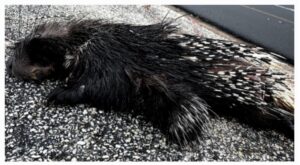
And not just a baby but a tiny porcupette frantically nudging at its mothers teats trying to get her to give milk! It was butting its head repeatedly on its mother so that it could get at the milk. The porcupette was damp, shivering and clearly hungry. It persisted and eventually it found a nipple and latched on. Squirming, the little one kept sucking away. I am not sure if it got any milk.
Video of the porcupette trying to drink: https://www.youtube.com/watch?v=mYy8w5epD2s
The porcupette was not there on the way out, so it must have been hiding in the bushes and in hunger and desperation came out later. The problem was that the mother, lying mostly on her chest, had been torn apart after being hit by a vehicle. She was dead. Her intestines were strung across the road in a big loop. The ribs on her back were visible, some seemingly missing, because her back skin, muscles and quills had been torn off by the impact. There were quills all over the road. Her little offspring, the porcupette, being so small, was not hit.
From the blood, quills and bits of flesh, it looked like the mother had been hit in the middle of the road! Had the driver tried to swerve to miss and unfortunately turned the same way as she ran? Or maybe, as some “low life” people do, purposefully aimed for her and hit her. Who knows, only that driver. Maybe the driver did not even see it! However, they will find chunks of porcupine across the car, as there was a lot of flesh and quills missing. Will it make them think about what they did? Maybe, maybe not.
Our righteous indignation kicks in …
Maybe the driver is a nature lover who was just travelling too fast to avoid the mother porcupine. How many of US drive too fast at times, on Clarence, and other roads, to be able to miss wildlife? How many birds, tortoises, rabbits, mongoose, genets, frogs, lizards etc. have we all hit?
This must make us pause and think – Me!
What am I doing? How am I harming the nature around me? From wheeled killing machines, to invasive plants, chemicals, unnecessary plant clearing, wasting water and on and on. It is easy to be indignant and point fingers at others, but are we striving to be better ourselves?
The Wildlife Rescue Centre has the porcupette. Support and help them! Help the poor animals who have ended up there because of US!
David, a concerned Betty’s bay resident
SLOW DOWN FOR LIFE ON THE R44!
Yesterday, we collected the body of a guinea fowl from the side of the R44. He had been hand-raised at the Kogelberg Biosphere Wildlife Rescue and Training Center, carefully nurtured over weeks until he was strong enough to return to the wild. We released him onto our property only days ago and he quickly earned the nickname “Cheeky” for wandering into our kitchen to steal birdseed. Like all our released birds, he wore a small SAFRING band on his leg for identification. He was killed right outside our gate.
Sadly, this is not an isolated tragedy. He is part of a growing and deeply troubling pattern along this stretch of the R44 between Betty’s Bay and Pringle Bay that involves all species.
A Road through a Living Landscape
Since we began operating in 2024, our centre has become acutely aware of the number of wild animals injured or killed along this road. Our data shows a constant increase in the list of species found on the section of the R44 between Rooi Els and Betty’s Bay. We see approximately 2 to 3 cases of road kill per week on our section of the R44, including mongoose, porcupines, Grysbok, and many more. The data we have collected points to an unsustainable situation. It is a priority to address this for the sake of the biodiversity of the Kogelberg.
The R44 cuts through the heart of the Kogelberg Biosphere, a national heritage site recognised for its extraordinary biodiversity. This is not an ordinary road. It passes through one of the most ecologically sensitive regions in the country — a place where wildlife must move freely to survive.
According to the Endangered Wildlife Trust, road deaths are not simply the result of reckless driving. They are the consequence of roads fragmenting once-connected habitats. Animals are forced to cross in search of food, mates, or refuge from fires and seasonal changes. Add high speeds and limited visibility at night and survival becomes a gamble.
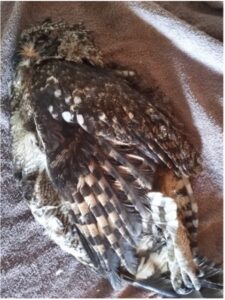

Left: A spotted Eagle owl: it was the third owl to be killed in the same area in four days
Right: another loss on the R44
Small to medium-sized mammals — genets, Cape clawless otters, honey badgers and antelopes are among the most frequent victims. Reptiles such as tortoises and snakes suffer heavy losses. Birds of prey are struck while hunting near road verges. We may wince as we pass a body on the tar, but too often we drive on.
The Human Risk
This stretch of the R44 carries a 100 km/h speed limit. From Rooi Els through to Betty’s Bay, vehicles accelerate through blind bends and narrow sections of road. There have already been human fatalities along this corridor.
Our rescue centre’s entrance lies along this very stretch. Although this entrance gate was rarely used, it is now in daily use by staff, veterinarians, volunteers, contractors and members of the public who respond to wildlife emergencies. The entrance is not clearly visible. Vehicles turning in or out must navigate fast-moving traffic on a partially blind rise, and we have already experienced near misses.
The uncomfortable question is this: how many human lives — or animal lives — must be lost before speed management is reconsidered on this section of road?
Michelle Watson, Kogelberg Biosphere Wildlife Rescue and Training Center
CONCERN ABOUT THE STATE OF BABOON MANAGEMENT
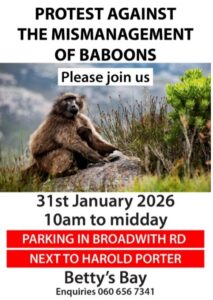
On 31 January, a well-organised and peaceful protest took place in Betty’s Bay regarding the current state of the baboon management.
The Betty’s Bay Baboon Action Group (BBBAG) agrees with well-disciplined, intelligent ‘monitoring’ using the ‘shepherd not shoot’ method as nobody wants baboons in houses. Also vuvuzelas to warn of baboon whereabouts and flagging on the busy R44.
What is critical to understand is that eliminating aggression leads to:
⁃ Calmer baboons,
⁃ Less hungry, thirsty/desperate baboons if they expend less energy from not being chased.
⁃ A more cohesive troop, allowing for the proper functioning of the vuvuzela system.
⁃ No trespassing on private property by monitors, causing less outrage from residents.
⁃ A return to the situation where community division was diminishing.
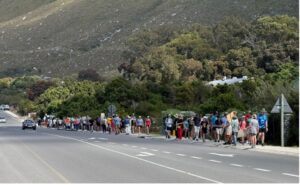
Betty’s Bay Baboon Action Group
UNSIGHTLY RUBBISH BINS ON THE SCENIC CLARENCE DRIVE, R44
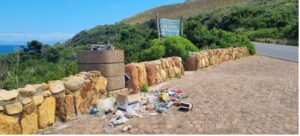
The Rooi Els Conservancy (REC) has taken up the issue of the messy and broken bins on Clarence Drive.
Over the past months, the bins were not been emptied regularly and the overflowing waste is blown into the vegetation and the sea. The bins also attract the baboons, which puts them in danger on the R44.
Recently, the REC Chairperson, Ralph Pina, was interviewed on Lunch with Pippa Hudson on CapeTalk to highlight this problem. His suggestion was to remove the bins and make this a bin-free zone so that the public takes their waste with them to dispose of it in a suitable manner.
The City of Cape Town implemented a bin-free policy on the peninsula at tourism hotspots. Their rationale is that the bins are removed to prevent baboons from foraging, reduce illegal dumping, minimise waste-attracting wildlife, and protect scenic, environmentally sensitive landscapes.
The BBC thanks REC for their initiative in this and supports them.

BBC SIGNS, T-SHIRTS AND YOUTUBE
BBC SIGNS
For members who might not be aware, we have members’ “Biosphere Living” signs that you can purchase to place at your house. If you have a plot that you do not intend to build on, we have a plot sign that you can purchase: “Plot purchased for the preservation of biodiversity”.
OUR BBC T-SHIRTS
BBC “Every day do one small act for biodiversity” T-Shirts
We have a few small and medium BBC T-shirts left. If you would like to buy one at R260, please let me know via WhatsApp on 079 7530166 or email bettysbayconservancy@gmail.com.
BBC YOUTUBE CHANNEL
 The BBC has created a YouTube account via its Gmail account.
Our first few videos are loaded and the links are in the above articles. If you have some lovely video clips relating to the biodiversity and beauty in Betty’s Bay, please WhatsApp Johan on 073 5439065. He will arrange to get them from you and add them to our YouTube channel.
Carol Clark