
During an iNaturalist vegetation assessment that CREW conducted for a new owner on a recently purchased plot, we uncovered several old animal traps hidden beneath thick undergrowth. The discovery is a cause for concern as our wildlife in the Kogelberg Biosphere is facing more and more threats.
The traps seem to be very old, but they can still pose a safety hazard and remind us of the fact that people still trap animals today. This discovery highlights the importance of regular plot inspections, especially on land that has been unmanaged for long periods.
Another aspect that is important to notice on vacant land is the appearance of alien invasive plants. If invasive plants are discovered early enough, it is easier to remove them as they can often be easily pulled out when they are still small. The invasive plants often spread from adjacent plots. Have a look around the gardens in your area and if you see that your neighbours have invasive plants in their garden, please try to negotiate with them to get the plants removed.

There is currently a huge problem with invasive bottlebrush in the field between Pringle Bay and Rooiels. It is of the Melaleuca family from Australia. These plants were grown in the area for a nursery and have started spreading in the last few years. They are now a big problem and very difficult to remove.
This is why it is important to follow the guidelines found in ‘Your place in the Kogelberg’ by Tim Attwell. It is available from the Harold Porter Gardens bookshop. There is also information in the articles shared by the Kogelberg Garden Circle about laying out your new garden or managing your old garden.
We have to take our responsibility seriously and consider what we plant. If you need help and advice, please ask.
Adele Scheepers, CREW
Custodians of Rare and Endangered Wildflowers
CULTURE AND THE ENVIRONMENT
Culture… mention the word and one thinks either of yoghurt or traditional dress (or for some of us, whipping out the charcoal for a braai). However, much of one’s culture is rooted and embedded in what you value. The visible expressions of a culture such as clothes, architecture etc. are secondary. This brings us to culture and the environment – and us.
‘Us’ being primarily westernised people living in the villages at the foot of the Kogelberg Mountains, in the Kogelberg Biosphere Reserve. We are typically goal orientated, materialistic and well educated and might be of British, Dutch, German or other historical lineage. Realistically, outside of language and some behaviours we do not have a visible culture.
 We live here or regularly visit, because we enjoy it here. Why do we like this area and how much do we VALUE it? If it was taken away from us tomorrow, e.g. we moved away or a tsunami swept away the villages, how much would the loss of the plants, animals, views, mountains and streams affect us? Would we mourn the loss?
We need to look into the values that we currently hold. We can change them to those we WANT to value. And change our thinking, actions and decisions, both daily and long-term, to come in line with our values.
The first steps are getting to know and understand the environment more. Spend time in it: observe, learn, show and be in awe and wonder about what is here. Here is an experience I had while I was thinking about the concept of value and culture:
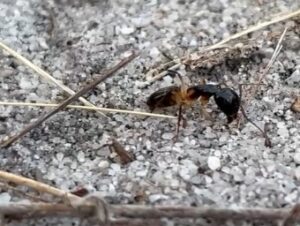
After a long day in the office, I sat on the garden bench, leaning on my knees and just staring with the “1000 yard stare” that comes naturally after a long Monday. After a while, I noticed something moving in the sand. There was a tiny, about 5mm or so, clump of grass moving around erratically. Not due to the wind as it was too erratic. Not an ant, as all I could see were grass bits. I looked longer, harder. I then noticed the ants scurrying around. Getting down on your hands and knees to watch some ants “anting along” can be interesting.
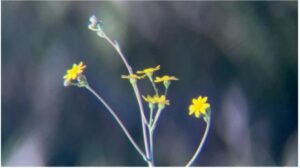 This led me to look at some TINY flowers. Complete flowers, but only around 3-4mm in length. Amazing! Then I saw a wasp dancing along inspecting every nook, cranny and hole in the sand.
Sitting back, my view got a bit larger. I noticed some of the fynbos plants, some claw marks in the sand, an antlion trap. Looking up, there were the starlings mobbing and bombing one of the ravens. That was so worth watching! These agile birds harrying and tormenting the lumbering raven. I sat back on the bench. Wow! So much to see and it was right there all around me.
 I live here because I WANT to see all that. I value it. But, is it part of my identify, my culture, the things that shape and define what I do and how I think? Yes, a bit, but. I need to place more importance on this treasure – and protect my treasure!
As villagers, do we value and treasure what we have here? Because only when we truly do, will we adapt our behaviour. Can I really say I value the wildlife if I do not get angry, heartbroken, and miserable when I stumble across the torn up body of a road-killed porcupine. Or not be horrified and traumatised by the sight of the porcupette butting its dead mother trying desperately to get milk.
If we value all that Betty’s Bay is, we should learn, experience, enjoy, teach, and share. To want to pick up the piece of litter we see. To want to protect the environment even though it may cost us money, time, and effort.
So that visitors look at us and say “Their CULTURE is to love, protect, enjoy and experience this wonderful place of the Kogelberg”
David, Betty’s Bay resident