
The first time I snorkeled at Betty’s Bay, I went looking for kreef and alikreukel, while my father-in-law was spearfishing. While I was immersed in the kelp, the sunrays filtered through the bamboes, dappled the rocks at the bottom, and it resembled a forest floor. I instantly understood why it is called a kelp forest. Taking hold of a piece of kelp and climbing down to the bottom, I gently scoped around. A curious Klipvis swam up and stared right at me, unafraid, until I waved hello and he jolted away. I like to think he was welcoming me into his world. Crayfish and alikreukel quickly escaped my attention, and it was the small things that would continue to invite me back into these waters.
I grew up in Guadalajara, Mexico, a city four hours away from the coast. There, on the few occasions I visited the ocean, I would see sandy bottoms stretching endlessly underwater. I would be lucky to spot anything interesting without effort. The waters at Betty’s Bay were entirely the opposite. Everywhere I looked was beaming with life. I saw a myriad of fish, algae, crustaceans, anemones, corals, and sponges composing magnificent views.
That curious Klipvis from my first dive also made me very curious. As a marine biologist who loves to identify all the animals I see, I needed to know more about Klipvis. I was surprised to find that there are 48 species of them endemic to South Africa! I became fascinated with Klipvis. Little did I know they were commonly caught by kids, and were a source of annoyance for anglers. I have now seen and photographed 11 species of Klipvis.
An exciting find was the Betty’s Bay Klipvis (Clinus exasperatus, below). Only discovered in 2012 by a Stellenbosch University professor, it was named exasperatus after the many exasperated attempts to find additional specimens.

Hanging in the water, keeping my body as still as I could, I spotted a fish merely 5 cm in length. Some species are masters of disguise, like this little Bluespot Klipvis (below). Since he relies on his colours and patterns to blend in with the algae, a diver can easily miss him. Other species like the Super and Autumn Klipvis, will swim right past you as you snorkel.
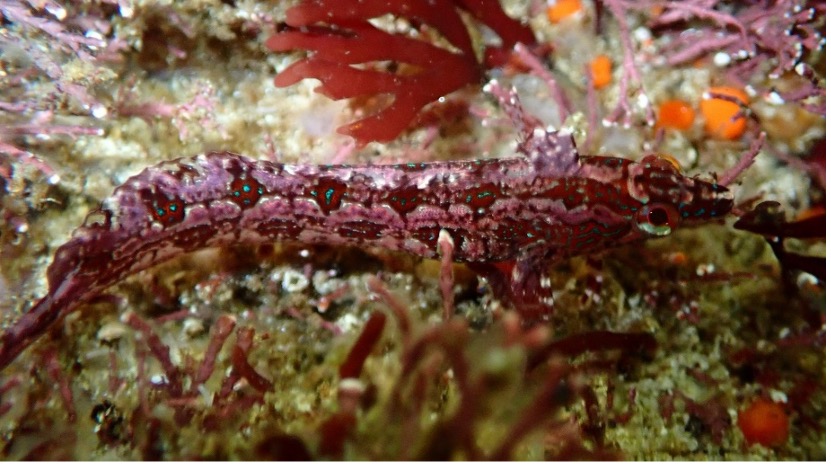
The diversity of marine life and beautiful seascapes of Betty’s Bay thoroughly amazes me. Whether I dive at Dawidskraal, Jock’s Bay, De Wets Bay, Bakboord, or explore the tide pools at Easter Beach and along Dolphin Drive, I know I will be in the presence of a truly unique environment. I find it unbelievable how these spots, though close by, can be so different. At De Wets Bay, I saw hundreds of ctenophores (comb jellies) floating in the water. At Jock’s Bay, I saw odd behaviors from Klipvis. I quickly recognized these as mating rituals. As a biologist, I was very excited about this rare event, since most fish fertilize their eggs externally as they float away. It turns out to be less rare than I thought! Klipvis mate constantly, and females can have multiple broods from different fathers at the same time.
I have only explored a small section of this coastline – unassuming from above, but an entirely different world under the surface. Fully exploring this small portion of coast will take a lifetime, which I look forward to very much. As I get out of the water at the end of every dive, I am welcomed back to the dry reality on the rocks. I leave the underwater world knowing it will be there in all its beauty, for the next dive.
Diederik Boonman