
 Many drivers may wince as they speed past the carcass of an antelope, porcupine or owl on the side of a busy road, but few pause to consider why roadkill is such a growing problem on our roads— or realize just how much it’s on the rise across South Africa.
Most roadkill involves small to medium-sized vertebrates. Serval, foxes, Cape clawless otters, honey badgers, African wild dogs, and various antelope species are among the most frequently killed. Reptiles like pythons, puff adders, and tortoises also suffer high mortality rates. Even birds of prey, including several owl species, are affected because they hunt near roads.
Part of the data collected by the Kogelberg Biosphere Wildlife Rescue and Training Center looks at the number of road fatalities on a particular stretch of road. The R44 – Clarence Drive – is a provincial road with a 100km speed limit between Rooi Els and Betty’s Bay. This road runs through the heart of a pristine biosphere and divides protected areas of the reserve. Since the center begun operating in 2024, the frequency of roadkill along this stretch of road has raised concerns, not only for the rehabilitated patients who are being released there, but also about the impact all of these deaths have on the biodiversity of the Kogelberg Biosphere.
Under-reporting is also a concern. Most roadkills go unrecorded, as scavengers often remove carcasses before they are logged, and many small animals are missed. Very few drivers will report an injured animal that might have disappeared into the bush to die.
The EWT has been monitoring some of South Africa’s roads since 2011, and has found that since 2012, more than 8,500 wildlife roadkill incidents have been recorded along just a few major toll routes. In 2024 alone, over 1,500 new incidents were reported on monitored highways, marking an increase over previous years.
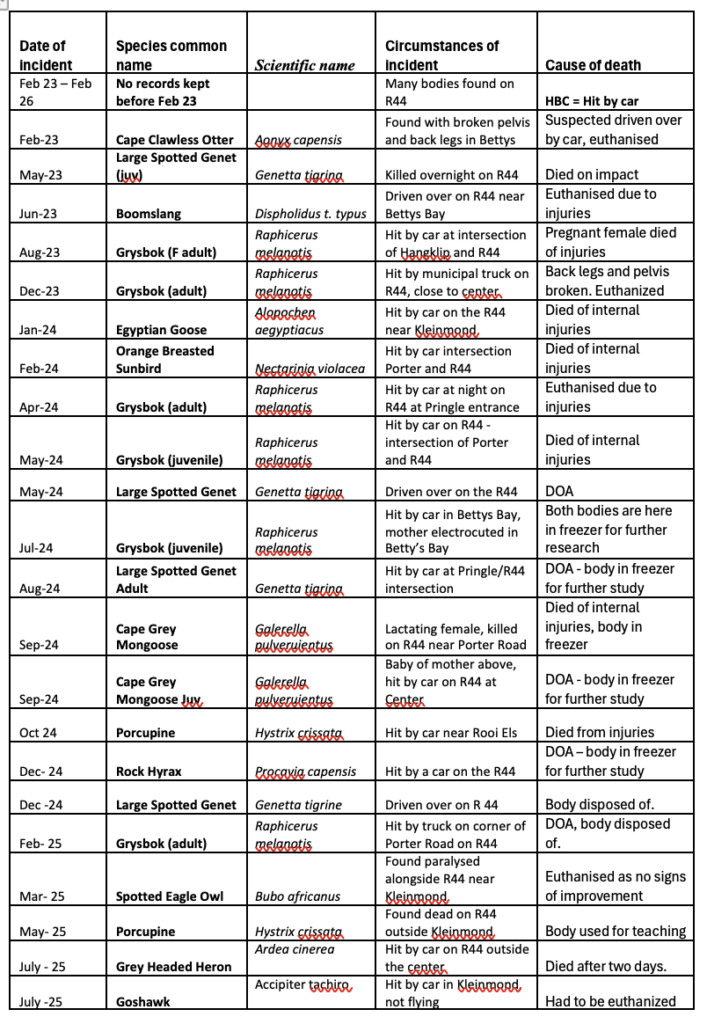
View the full report of road deaths here – https://bettysbayratepayers.co.za/wp-content/uploads/2026/03/R44-Clarence-Drive-Wildlife-and-Road-Deaths-February-2023.pdf
It’s not only about reckless driving. According to Thabo Hlatshwayo, an ecological researcher and senior field officer for the Endangered Wildlife Trust’s (EWT) Wildlife and Transport Project, the issue is rooted in roads cutting through once-connected wild spaces, shrinking habitats, and a changing climate – all of which force animals to move more often, putting them in harm’s way.
One part of the problem lies in how roads are designed. There’s a lack of consideration for what wildlife needs. Roads cut through habitats, leaving animals with few safe options to move between areas, especially when they need to escape threats like fire or to find food during seasonal changes.
Driver behavior is another factor. There is quite a lack of awareness of our surroundings and careless speeding. At night, nocturnal animals are at risk as visibility is low.
RoadWatch is an App developed by the Endangered Wildlife Trust and launched in 2013. The RoadWatch app allows members of the public to log wildlife roadkill sightings across South Africa. With nearly 30,000 records submitted to date, the data helps identify roadkill hotspots, inform conservation efforts, and guide road safety improvements.
The RoadWatch app is available as a free download on both Google Play and the Apple App Store.
The Kogelberg Biosphere Wildlife Rescue and Training Center has put together a R44 Task Team, to try to deal with the issue of the speed limit at a municipal level. Part of the role of a rehabilitation center is to tackle some of the bigger issues facing conservation efforts in South Africa and to work with government to mitigate wildlife fatalities.
Support driving 60km/h through our village on Clarence Drive by signing the petition below.
Michelle Watson CWR