
In an article published in the Argus on 10 July, titled Don’t Fall for the Big ‘Us‑and‑Them’, Rudi Buys explores how polarising narratives are used to divide communities, particularly in political contexts. He warns of the destructive consequences when groups are encouraged to see one another as adversaries, often leading to hostility, fear, and even violence.
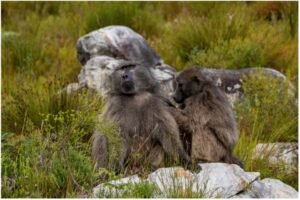
This pattern is sadly visible in Betty’s Bay, where discussions around baboon management have become increasingly fraught. A small but vocal group has adopted an ‘Us‑and‑Them’ stance that frames the baboons — and those advocating for their protection — as obstacles rather than part of the natural heritage of this biosphere. The result is a climate of tension in which misinformation, personal attacks, and calls for harmful action against these animals have begun to overshadow constructive, evidence‑based management.
The EMS Foundation has recently initiated High Court proceedings against both CapeNature and the Overstrand Municipality after efforts to resolve concerns about weapon‑based baboon management through formal correspondence did not yield the assurances sought. In its letter of demand, the Foundation requested that no weapons be used in managing the Betty’s Bay troop, emphasising that these animals form an important part of the Kogelberg Biosphere and should be protected in accordance with South Africa’s constitutional values, environmental legislation and humane conservation principles.
 On 9 June, the Overstrand Municipality confirmed that it was reviewing aspects of the current management approach — a step welcomed by the EMS Foundation. However, the suspension of weapon‑based interventions has not yet been implemented during this review period.
According to senior researcher Megan Carr, this left the Foundation with no option but to seek relief through the courts. Importantly, Dr Dean O’Neill, the Overstrand Municipal Manager, has called for a comprehensive review, grounded in biodiversity considerations, conservation science, public safety and animal welfare. The revised draft of the Strategic Baboon Management Plan (SBMP) is expected to be submitted to an independent panel of wildlife and conservation experts for specialist assessment by August.
Against this backdrop, the question that now faces Betty’s Bay is not simply how baboons should be managed, but how we understand our role within a protected biosphere. The current debate has revealed a deeper tension between development pressures and the responsibility that comes with living in an ecologically sensitive area. For some, the presence of baboons is seen as an inconvenience; for others, it is a reminder of the natural heritage that defines this place. The challenge before us is to move beyond entrenched positions and consider what it truly means to share a landscape with wildlife that has inhabited it for generations.
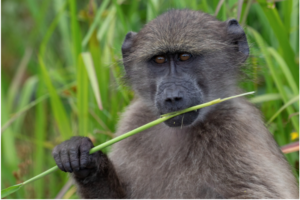 The recent kind of rhetoric witnessed has no place in a community situated within a protected biosphere. Living in Betty’s Bay is a privilege, and with that comes a responsibility to conserve and preserve the natural environment of which we are part. It is difficult to reconcile the idea of living in a biosphere with calls for the eradication of the very wildlife that defines it. Recently, a few members of our community used highly inflammatory language on social media, calling for harm to the local baboon troop. Such statements highlight how far the conversation has drifted from evidence‑based management and respectful coexistence, and how urgently we need to return to principles of stewardship and shared responsibility.
Living in a biosphere carries obligations that cannot be set aside when they become inconvenient. The baboons are not intruders; they are part of the ecology of this region, forming an integral part of its history long before any of us arrived. As the review of the Strategic Baboon Management Plan proceeds, we have an opportunity to reset the conversation — to move away from polarisation and towards science, ethics and long‑term conservation. The question before us is simple: do we honour the principles of the biosphere, or do we abandon them? Our answer will define the legacy we leave in Betty’s Bay, for both the community and the wildlife that shares this landscape.
Patrick Bolttler
Photos: Pete Oxford