
BETTY’S BAY – A COASTAL COMMUNITY AT A CROSSROADS
Betty’s Bay has long been recognised as one of South Africa’s ecological treasures. I was fortunate to serve on the editing team of Betty’s Bay: Between Mountain and Sea, a project that unfolded over ten months of dedicated work. The result was a 639‑page coffee‑table book created with one purpose in mind: to honour this stunning place in all its splendour.
 The book was dedicated to the Betty’s Bay community, past and present. It does not claim to be the final word, but rather an invitation to reflect, to engage, and to continue safeguarding the heritage of a landscape celebrated for its exceptional biodiversity and environmental significance within the Kogelberg Biosphere.
What emerged clearly through the project is that Betty’s Bay is a place of great ecological importance. Its richness lies in the huge variety of flora and fauna: the African 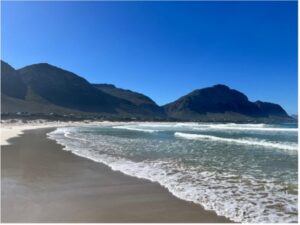 Penguin colony, the diverse fynbos species, wetlands, floodplains, vleilands, estuaries and rivers, marine ecosystems, dune systems, mountain slopes, night skies, the Harold Porter National Botanical Garden, archaeological sites, and the Cape chacma baboon troops. More than 270 bird species, along with amphibians, reptiles and small mammals, call this place home.
Protecting these natural assets are long‑standing organisations such as the Botanical Society and the Hackers – whose collaboration dates back to 1974 – as well as the Betty’s Bay Conservancy, established in 2005. The Overstrand Municipality and the Betty’s Bay Ratepayers Association also commit, in their mandates, to sustainable development, service delivery and environmental conservation.
The book also traces the history of Betty’s Bay: the pioneering families who shaped the early settlement from the 1930s, the development of homes and local businesses and the growth of community initiatives such as the Pikkewyntjies Pre‑School, the Parkrun, the Jukskei Club, the Hangklip Community Care Centre and the Wildlife Rescue and Training Centre.
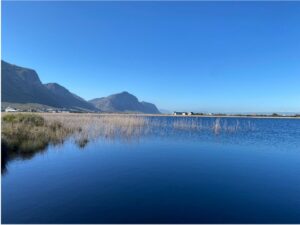 Today, however, Betty’s Bay stands at a crossroads. The pace of development has accelerated, placing increasing pressure on the environment. Many new residents arrive with a genuine desire to preserve the area’s natural character, yet the cumulative impact of construction, particularly on wetlands and sensitive ecological zones, is becoming difficult to ignore. Large homes, extensive paving and infill in vulnerable areas can alter the landscape in ways that are not easily reversed.
This shift has consequences. Our baboon troops face growing challenges, the African Penguin colony remains under significant threat, and the fynbos, wetlands and associated fauna are increasingly vulnerable. These pressures highlight the need for thoughtful, responsible planning that balances community growth with ecological stewardship.
 So, what is required? Quite simply, broad community commitment. Preserving Betty’s Bay depends on collective effort – on residents, organisations and authorities working together to ensure that development aligns with the long‑term wellbeing of the biosphere. When more voices champion conservation, the path forward becomes clearer: a future in which this beautiful landscape is protected, respected and sustained for generations to come.
By Patrick Bolttler