
Betty’s Bay’s Seasonal Wetlands
A simple pleasure on a quiet winter’s evening in Betty’s Bay’s flat coastal plain is the sound of rain and numerous frog calls – if the wind isn’t roaring! The cacophony of clicks from Clicking Stream frogs, Strongylopus grayii, compete with the tapping and groaning kua-kua calls of the Cape River frog, Amieta fuscigula, rising in volume with increasing competition. A keen listener will make out the low- pitched scratching tshk-tshk of the endangered Cape Microfrog, Microbatrachella capensis, and the creaking sound of the Cape Caco, Cacosternum capense.
Of course, these sounds are made by male frogs hoping to attract a female for nocturnal shenanigans, resulting, in due time, in scores of tadpoles.
But these sounds not only denote romantic froggy affaires de coeur, but also the health of the ecosystem from which they emanate. Frogs will only breed and flourish in fully functioning environments. Frogs don’t know that, but we humans do. If we hear frogs calling in numbers, we can rest assured that in those particular locales, all is right with the world – for the time being.
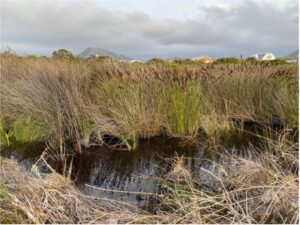 The locale in question is Hangklip Sand Fynbos, a vegetation type that is characterised by seasonal wetlands, under water only in winter, where restios, mainly Elegia tectorum, predominate. As we pass into summer, these same wetlands host exquisite purple-pink flowered Sea Roses, Orphium frutescens, with their twisted yellow axils, which only release their pollen when their carpenter bee pollinators buzz close to them at a frequency which approximates to middle C on a piano.
Surrounding these seasonal wetlands are conebushes, in the Protea family, of the genus Leucadendron, which provide splashes of sunshine yellow to the landscape in winter. Erica species, notably E. coccinea, with their yellow but sometimes red ‘hangertjie’ flowers, Buchu species, Rutaceae, such as Confetti bush or Aasbos, Coleonema album, release a distinctive scent when brushed, add to the abundance of the environment. Orchids in the genus Satyrium appear in Spring, orange S. coriifolium and pink S. carneum and occasionally the endangered S. hallackii. Taller shrubs such as Fonteinbos, Psoralea pinnata, provide blue pea-flowers as the drier months of summer set in.
Those of us who live in these parts may have become over familiar with this landscape and take it for granted, seldom looking at it closely.
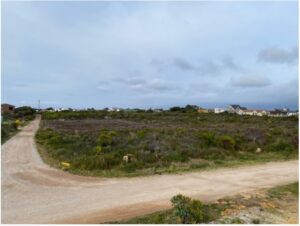 The flatness of the area provides prime real estate close to the sea for the erection of houses, bringing the need to alter the land, filling in hollows with rubble in order raise our houses above the underlying and seasonally overlying water. This replaces the existing plant and animal communities with gardens of our own design, interrupting the natural movement of water, plants and wildlife. Erven, which have been bought in anticipation of later building operations, are sometimes left to invasive alien plants such as Rooikrans, Acacia cyclops, Port Jackson Willow, Acacia saligna, Australian myrtle, Leptospermum laevigatum and Spider Gum, Eucalyptus conferruminata, among others.
Public open spaces, some zoned for conservation and others for public use, are precious remnants in our area, where the integrity of the ecosystems that make Hangklip Sand Fynbos what it is has to be used with the utmost care. The integrity and efficacy of these areas depend on their interconnectedness. The fragmentation of the ecosystem into isolated pockets inevitably diminishes their functionality and biodiversity.
One of the fathers of modern ecology, Aldo Leopold, wrote in his book ‘A Sand County Almanac’ (1949): “We abuse land because we regard it as a commodity belonging to us. When we see it as a community to which we belong, we may begin to use it with love and respect,”
Leopold’s plea is made especially relevant in the latest report (4 August 2026) of the South African National Biodiversity Institute’s (SANBI’s) National Biodiversity Assessment (NBA) dealing with Ecosystem Threat Status. Just as organisms are listed as Near Threatened, Vulnerable, Endangered, Critically Endangered and Extinct, so are ecosystems, except that ecosystems aren’t categorised as Extinct, but as ‘Collapsed’.
In this report, Hangklip Sand Fynbos is ‘Critically Endangered.’ That’s one step away from ‘Collapsed,’ when the frogs will be silent.
Tim Attwell