
 Mike Markovina has lived his whole life in Betty’s Bay. He was introduced as an unsung hero within our community, one of us.
He is a brilliant marine scientist and was integral to the Betty’s Bay (and beyond) Baited Underwater Remote Video (BRUV) studies that looked at biodiversity and biomass in the Marine Protected Area (MPA). These studies provide scientists with the critical baseline data they need for comparative studies. He is also a superb boat captain and a core member of the Kleinmond Branch of the NSRI, where he is a training officer.
It was a full house as Mike took us on a journey, telling a story of hard, dangerous, and real marine conservation — no fluff. One attendee remarked, “It’s like being in a Jason Bourne movie.” From previous conversations with Mike, I know we were only told the PG-13 version!
His journey began in Gabon in 2007, stationed where the pristine rainforest meets the ocean — a privileged location where forest elephants shared the same beach and chimps called from within the forest. He was tasked by the Wildlife Conservation Society to undertake joint fisheries patrols with the government to tackle the scourge of “Illegal, Unreported, and Unregulated” (IUU) fishing in the Mayumba Marine National Park.
With that experience under his belt, he was called to Tanzania — initially to conduct Monitoring, Control and Surveillance missions and training, but that required a deep focus on blast fishing.
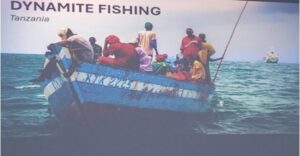 Dynamite fishing was the issue. Daily, up to 150 homemade ‘dynamite’ bombs were blasting the reef along the coastline.
The effect was catastrophic, levelling the reef to two-dimensional rubble with no chance of recovery. The reef structure is the pillar of biomass and biodiversity; the bombing was entirely non-selective, killing everything, causing huge ecological destruction and socio-economic pain.
Together with his multi-disciplinary team, from the highest levels of government and law enforcement, they dived into the underworld to cut the head off the snake and drastically reduce the supply of explosives to the illegal fishing community. Their efforts are estimated to have led to a 90% decline in dynamite fishing! And to the establishment of the Multi-Agency Task Team (MATT) for fishing, fisheries, and wildlife crime in Tanzania. This was ratified by the government in 2015.
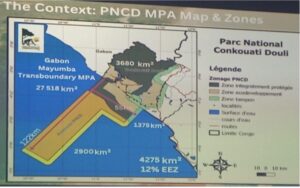
After those six years, he gathered a team to develop a marine anti-poaching force in a remote location in Congo. Scraping together basic hardware while intelligently applying the latest technology, a team was trained and, against all odds, became a major success story. The Congo’s Conkouati-Douli National Park now has an effective marine protection unit!
Back home, Mike is currently co-developing similar technology for the Kogelberg Biosphere Reserve. The applications could have far-reaching effects on local conservation, both in the marine and terrestrial environments. The planned structure is to ensure that the community and public can be harnessed in an observational capacity through an application linking observation to real-time management decisions. The hope is to provide authorities with relevant information while providing oversight of official response.
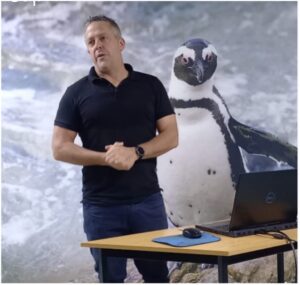
Mike’s talk spoke loudly to ‘The Power of One’ and building a story around the problem in order to identify solutions.
Pete Oxford
Photos: Carol Clark