
September is “International Coastal Clean-up” (ICC) month!
The BBC shifts its usual “4thSaturday” event to the third Saturday of September to participate in the ICC.
This year, we had a double event. To highlight the impact of pollution and destructive human activities on oceans, we screened Sir David Attenborough’s OCEAN on Friday 18 September, the evening before the clean-up.
OCEAN by Sir David Attenborough
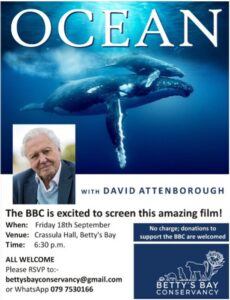 I saw OCEAN for the first time at the BBC event.
What a phenomenal achievement by Sir David Attenborough to complete this project when he was nearly 100 years old!
For those who don’t snorkel or scuba dive, films like this bring the hidden ocean world to life – exquisite, colourful, and incredibly diverse. Left untouched, these marine ecosystems thrive.
But man destroys things.
For me, one of the most shocking scenes was the industrial bottom trawlers destroying the seabed. Boats drag heavy chains or a beam along the seabed, scour the floor, and force everything in the path into the net behind them. They often look for just one species, and over three-quarters of their catch may be thrown away. Vibrant, colourful diversity and ecosystems end as shattered bits of nothingness in a grey swirl of destruction.
View the scene at the link below.
Click below to view the scene
Never-before-seen footage of bottom trawling released from Ocean …
Another chilling scene involves huge krill factory ships in Antarctica, hauling and processing tons of krill daily, near penguin colonies that rely on krill for food. How long before these penguins, and other marine creatures who feed on krill, are left with a radically diminished food supply and the resulting impacts? An example of the effects of overfishing and diminished food sources for penguins lies close to home. At Stony Point and other African Penguin colonies, commercial fishing has severely impacted the population.
It seems that man, with a short-sighted focus on profiting from the ocean, causes so much devastation, with no thought of the long-term impact.
After highlighting examples of destruction in the film, positive examples of where protection has been put in place, and marine ecosystems have the opportunity and capacity to restore, are also shown.
I think the destructive scenes stay in one’s mind – reflecting how removed people can be from the impacts of their actions when money is at stake; they focus on immediate gain, don’t care about the effects, or have no interest in long-term impact. That obviously applies to so many scenarios in terrestrial ecosystems too.
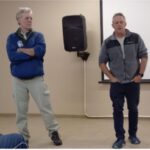 Thanks to:
- Leon du Toit and Patrick Bolttler for sponsoring the hire of Crassula Hall for the screening.
- Pete Oxford and Mike Markavina for their input and discussion after the film, and for highlighting the need to protect the Betty’s Bay Marine Protected Area (MPA).
Carol Clark
INTERNATIONAL COASTAL CLEAN-UP (ICC)
Everyone enjoyed a great day at the big ICC Betty’s Bay Cleanup. The wind calmed down, and the weather was kind to the volunteers, including several enthusiastic learners from four local schools.
Betty’s Bay had seven shoreline sites to clean up. It was a pleasant surprise to see less rubbish on our beaches.
In Sunny Seas, which has a rocky shore, we cleaned the roads and drainage ditches, boosting the total number of FULL bags to 61. We collected the usual bottle tops, as well as hundreds of plastic bits and degrading plastic bags. The balls of fishing line and builders’ rubble are always a great concern. Some of the most unusual things collected were a long aluminium fascia board, a hearing aid, an old oystercatcher signboard, a panga and a fishing knife.
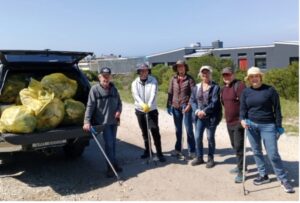
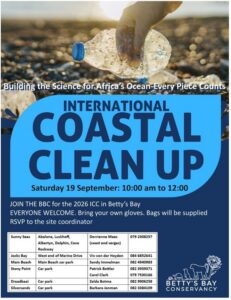
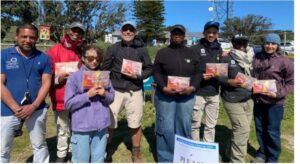
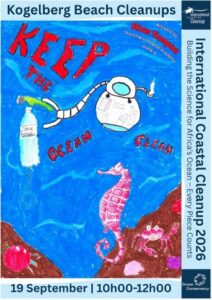 There were 16 volunteers at Stony Point, including the friendly and supportive staff from CapeNature. We collected five bags of trash. Of note were a faded road cone, a broken plastic chair, and old signage. We had the cutest, spunky, and most enthusiastic learner helping us, Candice. Some of her fellow learners, her lovely parents, and brother joined her. He won the artwork competition for the ICC, and his picture was used as the poster for the 2026 clean-up. Thanks to all who helped and to Robert for his great organisation.
Thanks to the volunteers who helped to clean at Draad Baai: Zelda, Mercia, Ann and Graham.
The five volunteers at Jock’s Bay found little to pick up along the coastline apart from a fair amount of fishing line, a few condom packets, plastic bottles, snack packets, and bits and pieces that filled less than half a bag. We then filled three bags with rubbish found on both sides of Clarence Drive, from Coffee on Clarence to Cliff Road. Many thanks to Wendy and Gordon, Andrea and Tony, for their enthusiasm, cheerful labouring and company!
Thanks to Sandy for coordinating at Main Beach. They found the beach in pristine condition with little to pick up.
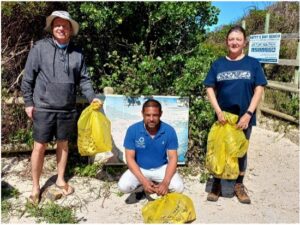 Big thanks to Robert Kyser of Pringle Bay for including us in helping with collation of data for the OCEAN CONSERVANCY and to others who fight the good cause at international treaties to minimise plastic manufacturing in the world.

The most unusual item collected was a hearing aid! Pity the poor ex-owner – they say sometimes the wind can blow them off!
Thanks to everyone who helped at the International Coastal Cleanup and to Robert for all his time and effort in another successful ICC.
Compiled by Barbara Jenman. Photos and feedback from the coordinators