
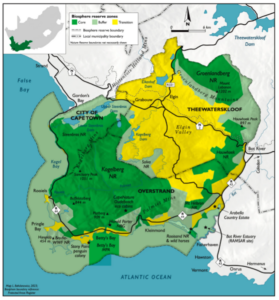
 Something I’m hearing more and more, and I don’t know if I’m the only one, is that Betty’s Bay is not part of the Kogelberg Biosphere Reserve, and that the biosphere applies only to the mountain and the Kogelberg Nature Reserve. I mean, really, what next? There seems to be some confusion between the Nature Reserve and the Biosphere Reserve. One is a protected mountain; the other is a UNESCO‑designated living landscape, and Betty’s Bay forms part of this biosphere.
 The claim that Betty’s does not form part of the biosphere is factually incorrect and carries serious consequences. Any concerned resident living here knows exactly why this narrative tends to surface in development‑aligned discussions. It undermines decades of conservation work, weakens environmental protections, and opens the door to development that is fundamentally incompatible with the ecological character of this place. It often overlooks the ecological realities of the very wildlife that makes Betty’s such a wonderful place.
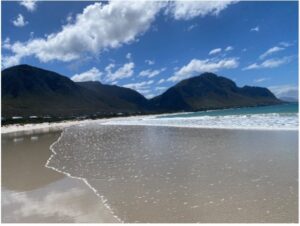 One can almost admire the creativity. After all, it takes a certain imaginative flair to stand in a coastal town surrounded by fynbos, wetlands, lakes, dunes, penguins, porcupines, otters, grysbok, and baboons and declare, with a straight face, that we are not in a biosphere. It’s like insisting that Table Mountain is not in Cape Town.
Globally, there are 784 UNESCO biospheres across 142 countries, forming the World Network of Biospheres — and Betty’s Bay is one of them. Approximately 300 million people — about 4% of the world’s population — live in biosphere reserves. It can be done. In Costa Rica’s Savegre Biosphere Reserve, entire towns and farming communities live alongside jaguars and cloud forests. On Spain’s island of Menorca, 95 000 residents inhabit a biosphere that balances tourism and conservation. In Germany’s Rhön Biosphere Reserve, villages and farms operate within protected landscapes. Jeju Island in South Korea, home to more than 600 000 people, is also a biosphere reserve. Living in a biosphere is not unusual — it is a globally recognised model of sustainable living, and Betty’s Bay is part of that model.
Today, as development pressures mount and tourism campaigns intensify, this divisive narrative has begun to circulate.
 If you really want to see biosphere denialism in action, simply mention — at any social gathering of people you don’t know very well — that:
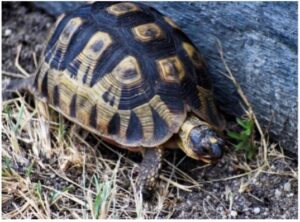
- baboons should be managed humanely • porcupines, tortoises and moles are welcome garden guests • scorpions, spiders and snakes are not the apocalypse • shoreline fishing in Betty’s Bay should be paused so stocks can recover • the speed limit on Clarence Drive should be reduced to 60 km/h • and (heaven forbid) that Betty’s Bay is part of a biosphere
You don’t need to be adept at reading a room to see it shift. Watch the body language.
It’s weird how a simple geographical detail, offered in kindness, can be misinterpreted as something provocative.
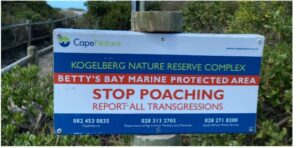 Let me state this loud and clear: Betty’s Bay is part of the Kogelberg Biosphere Reserve.
The facts are clear and publicly documented. Betty’s Bay lies within the 100,000‑hectare Kogelberg Biosphere Reserve, South Africa’s first UNESCO‑designated biosphere (1998). The reserve includes the town itself, its coastal ecosystems, freshwater lakes, dunes, and its marine protected area.
- Cape Coastal Homes describes Betty’s Bay as “nestled within the 100 000 ha Kogelberg Biosphere Reserve” and as “an urban conservancy” where wildlife roams freely.
- The Betty’s Bay Marine Protected Area — home to the endangered African penguin colony — is explicitly part of the core zone of the UNESCO Kogelberg Biosphere Reserve.
- Local conservation organisations, including the Betty’s Bay Conservancy and CapeNature, operate specifically because the town is situated inside the biosphere and must uphold its conservation ethos.
- The biosphere is not a distant mountain concept. It is our coastline, our lakes, our dunes, our gardens, our roads, our homes. It is the living system we inhabit every day. • The signs erected at the entrances to Betty’s Bay clearly state: “Welcome to Betty’s Bay, part of the Kogelberg Biosphere.”
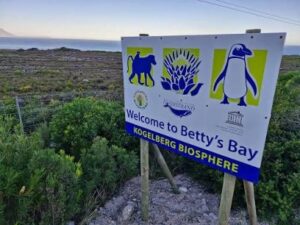
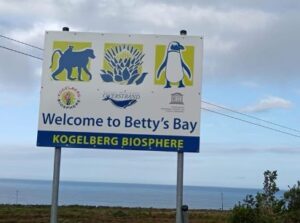
To claim otherwise is to erase the ecological truth of Betty’s Bay and to clear the way for development that would irreversibly damage the very environment that sells this place as a tourist mecca.
Recent municipal messaging and campaigns emphasising tourism growth have begun promoting Betty’s Bay as a future “tourism hub”, with increased visitor numbers, expanded commercial zones, and intensified infrastructure. A proposed shopping complex next to Crassula Hall is beyond comprehension. Do we really need this?
To be clear, tourism, when carefully managed, can support conservation. The new hiking trail is a great example of responsible tourism. See https://penguintrail.co.za
But tourism without ecological limits, tourism that treats the environment as an expendable backdrop rather than a living system, threatens everything that makes Betty’s Bay unique.
The argument that Betty’s Bay is “outside the biosphere” is not merely an innocent misunderstanding; it is a narrative that has the effect of weakening environmental protections, reducing conservation obligations, and justifying development that would never be permissible within a recognised biosphere reserve.
If accepted, this narrative:
- undermines biosphere zoning and conservation guidelines
- increases pressure for commercial expansion
- threatens wildlife corridors and breeding sites
- accelerates habitat loss in wetlands, dunes, and fynbos
- places the African Penguin colony and other species at even greater risk.
This is not a theoretical concern. We already see wetlands filled with building rubble, large houses replacing natural vegetation, and wildlife displaced from areas they once freely roamed.


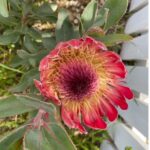
The Kogelberg Biosphere is globally exceptional. It contains the highest concentration of plant biodiversity per square kilometre anywhere on Earth, with over 1 600 fynbos species, many of them endemic.
Our dunes, lakes, coastal vegetation, and marine ecosystems form an interconnected ecological web. The biosphere designation exists precisely to ensure that human activity remains compatible with this fragile environment.
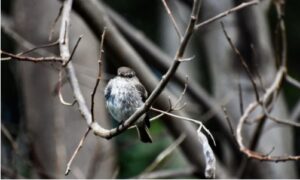 If Betty’s Bay is to remain a sanctuary rather than yet another overdeveloped concrete landscape, we must reaffirm our commitment to conservation. EIAs (Environmental Impact Assessments) must be completed responsibly. We must all play some role in digging in our heels and saying: enough. We’ll support development only when it respects and protects our wildlife.
Betty’s Bay can strengthen its biosphere identity by enforcing conservation‑aligned development rules, protecting wetlands and dunes, limiting paving, using indigenous vegetation and managing traffic impacts on Clarence Drive. Maintaining wildlife corridors, safeguarding the African Penguin colony and marine ecosystems and ensuring humane baboon management are essential to preserving ecological integrity. A shift toward low‑impact, nature‑based tourism — supported by initiatives like the new hiking trail — reinforces this ethos. Local conservation groups (BBC, Hackers, CapeNature and BotSoc) must be empowered to guide decisions, while clear signage, community workshops and school programmes help residents and visitors understand that living in a biosphere carries shared responsibility.
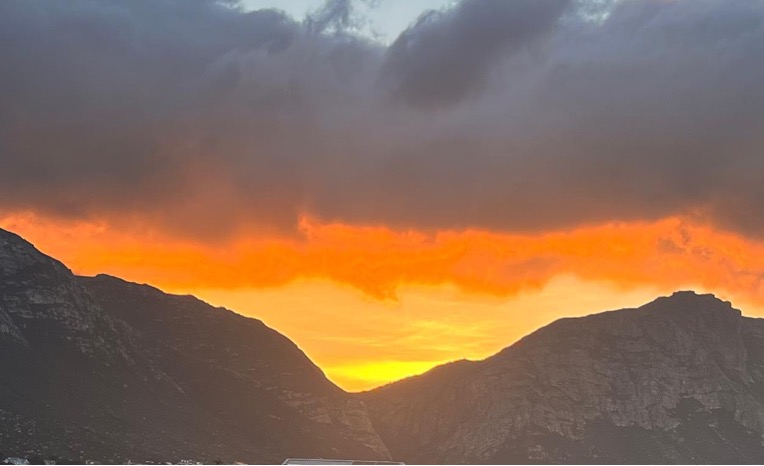
The truth is simple: Betty’s Bay is part of the Kogelberg Biosphere Reserve. It always has been. And it is our responsibility and privilege to protect it.
Patrick Bolttler