
LIVING WITH NATURE: UNDERSTANDING UNESCO BIOSPHERE RESERVES
Across the world, humanity faces a growing challenge: how do we protect our natural environment while allowing communities to develop, prosper, and improve their quality of life? For decades, conservation and development were often regarded as opposing interests. UNESCO’s Biosphere Reserve Programme was established to demonstrate that the two can, and indeed must, coexist.
 In 1971, UNESCO launched its Man and the Biosphere (MAB) Programme, an international scientific initiative aimed at improving the relationship between people and their natural environment. The programme recognises that human beings are not separate from nature, but form an integral part of the ecosystems upon which all life depends.
A biosphere reserve is therefore much more than a traditional nature reserve. It is an internationally recognised area where biodiversity conservation, sustainable economic development, scientific research and community participation are brought together within a common framework. Today, UNESCO’s global network includes more than 700 biosphere reserves across more than 140 countries, each contributing to a worldwide effort to develop practical models for sustainable living.
The concept rests on three fundamental principles: conservation, sustainable development, and education and research. Conservation seeks to protect ecosystems, species, and genetic diversity. Sustainable development encourages responsible economic activities that benefit local communities without destroying the natural resources upon which they depend. Research, education and monitoring provide the scientific knowledge needed to understand environmental change and guide responsible decision-making.
To achieve these objectives, biosphere reserves generally comprise three interconnected zones. The core areas contain legally protected ecosystems of particular conservation importance. Surrounding these are buffer zones, where compatible activities such as environmental education, research and ecotourism may take place. Beyond these lie the transition areas, where people live, work, farm and conduct business while pursuing environmentally responsible development. Importantly, UNESCO recognition does not transfer ownership or governmental authority to UNESCO. Biosphere reserves remain subject to national legislation and local governance. Their success depends largely on cooperation between government, scientists, conservation organisations, landowners, businesses and local communities.
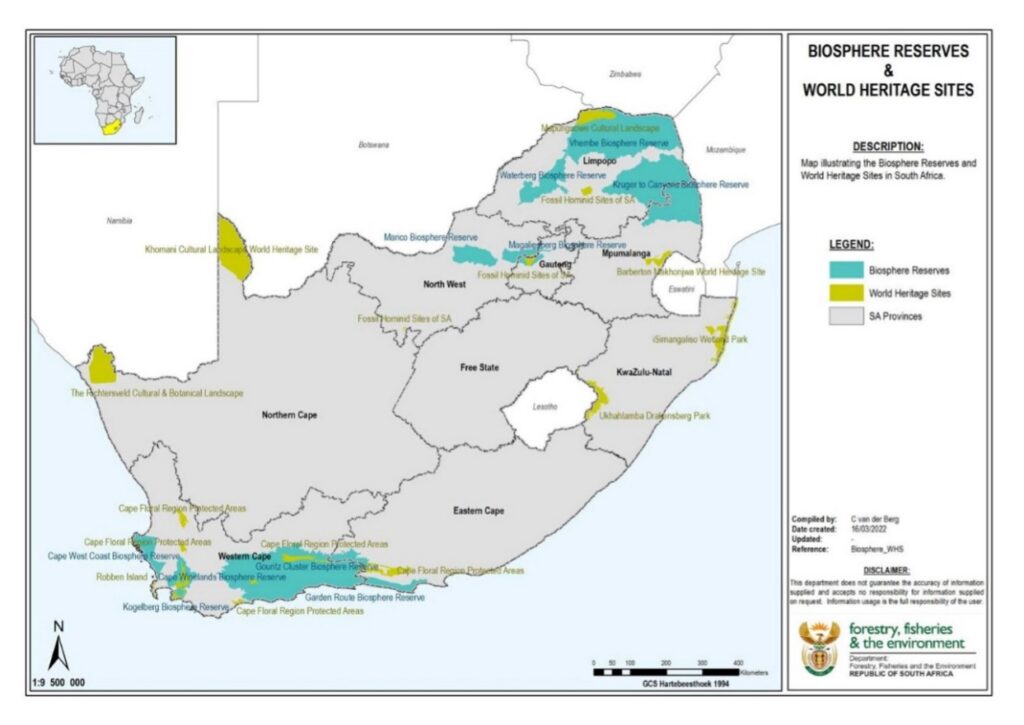
In 1998, South Africa entered this international network when the Kogelberg Biosphere Reserve became the country’s first UNESCO-designated biosphere reserve. Situated in the Western Cape, this remarkable landscape represents one of the world’s most extraordinary concentrations of plant biodiversity. Yet its international recognition carries a responsibility extending far beyond protecting rare plants. It challenges everyone living and working within its boundaries to consider how conservation, development and community wellbeing can become mutually reinforcing objectives.
Ultimately, a biosphere reserve is not simply a place on a map. It is a commitment to a different relationship between people and nature, one in which protecting our natural heritage becomes an investment in the future of our communities and generations still to come.
Johan West
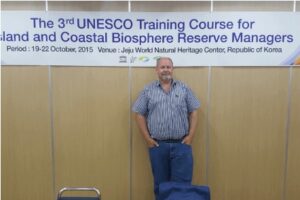 About the author: Johan West is a former long-standing director of the Kogelberg Biosphere Reserve Company (KBRC), having served as its Chairman from 2012 to 2017. He was also chairman of the Western Cape Biosphere Reserve Forum for two years and served on the Board of the Cape West Coast Biosphere Reserve. He currently serves on the Finance Committee of the South Africa’s National Man and the Biosphere (MAB) Committee and is a member of the AfriMAB Panel of Experts.